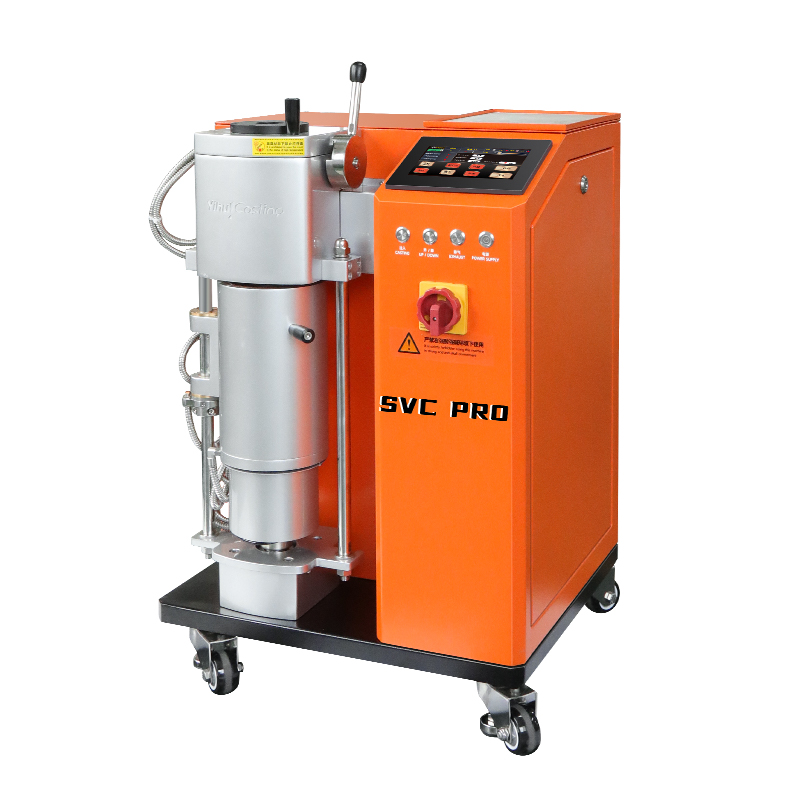
Traditional gravity casting leaves air pockets, porosity, and incomplete fills — especially in intricate filigree and micro-detail jewelry designs. Vacuum pressure casting machine technology solves these problems by evacuating the mold chamber before injecting molten metal under controlled pressure (up to 0.2 MPa).
Per ASTM B928 testing standards, vacuum-cast jewelry achieves porosity levels below 0.5% — compared to 3-8% for conventional gravity methods. First-pass yields jump from 70-85% (gravity) to 92-98% (vacuum). Precious metal casting equipment with argon gas protection further reduces oxidation-related defects.
Vacuum casting produces surface roughness (Ra) of 0.8-1.2μm vs 3-6μm for gravity-cast pieces. Combined with electrolytic polishing machine processing, finishing time drops 40-50%, and final surface quality reaches mirror-grade standards.
The same vacuum pressure technology achieves ±0.05mm accuracy for dental frameworks (ISO 6872 compliance) and minimizes grain-boundary defects in aerospace-grade titanium and cobalt-chrome alloy castings.
Yihui Casting Technology — established 2003 in Guangzhou Panyu — operates 5 factories (32,000 sqm), 300+ staff, and holds 40+ patents. ISO 9001:2015 certified, serving 5,000+ manufacturers across 60+ countries with measurable defect reduction data from real production environments.
If defect rates above 5% are eating into your margins, vacuum pressure casting isn't optional — it's the mathematically proven solution. Switching from gravity to vacuum casting delivers 60-80% defect reduction, 92-98% first-pass yield, and 40-50% less finishing time. These numbers come from 60+ countries of real production data.
 online service
Scan to wechat :