Selecting the right casting machine is not just a technical decision — it is a strategic investment that determines your defect rate, material loss, and production capacity for years to come. At Yihui Casting Technology, with 21+ years serving 5,000+ manufacturers across 60+ countries, we have seen workshops lose 8-15% of their precious metal inventory to mismatched equipment. This guide provides a systematic framework for matching casting machine type to your specific metal and production volume, using real production data from ISO 9001:2015-certified facilities.
Different precious metals require fundamentally different casting approaches. Gold (melting point 1,064°C) flows easily into fine detail, while platinum (1,768°C) demands higher energy input and specialized crucibles. Silver (962°C) oxidizes rapidly in open atmospheres, requiring gas protection during both melting and casting.
Per ASTM B928 standards, the critical metal-casting correlation involves three parameters: melting temperature range, viscosity at casting temperature, and oxidation sensitivity. Gold and silver benefit from precious metal casting equipment with argon or nitrogen gas shielding, which reduces oxidation-related defects by 60-80%. Platinum, due to its extreme density (21.45 g/cm³) and narrow solidification window, performs best under centrifugal force that compensates for its sluggish flow characteristics.
Production volume determines your machine's capacity requirement — and your total cost of ownership. A low-volume artisan workshop casting 2-5 flasks per day has entirely different needs than a factory running 50+ casts daily.
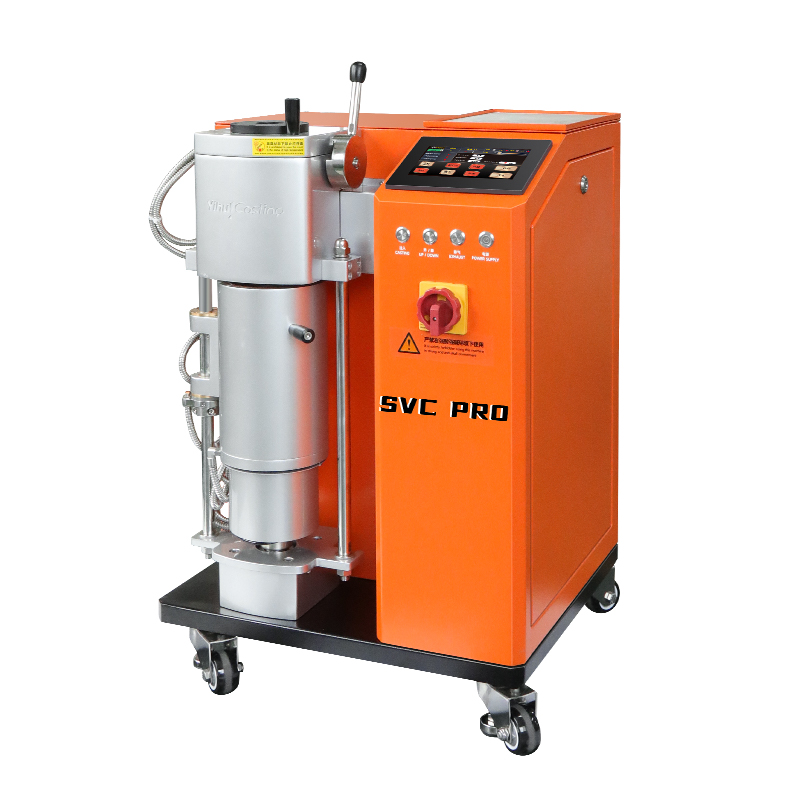
Low Volume (2-5 flasks/day): A compact vacuum pressure casting unit with 1-2.5kg melting capacity handles most gold, silver, and copper alloy work. The vacuum pressure casting machine AVC-EV model, with 2.5kg capacity and 1,000 memory programs, allows rapid switching between alloy formulations without manual recalibration — critical for small workshops serving diverse client requests.
Medium Volume (10-30 flasks/day): Semi-automatic models with multi-flask processing reduce cycle times. The DVC-II processes 2-3 flasks simultaneously, cutting per-cast time from 8-12 minutes (manual) to 3-5 minutes (semi-auto). First-pass yield jumps from 70-85% to 92-98% per ASTM B928 benchmarks.
High Volume (50+ flasks/day): Fully automatic machines with continuous casting capability become essential. Gas-protected continuous casting systems with 8kg capacity and Omron PID temperature control (±2°C) maintain consistent alloy chemistry across extended production runs, reducing batch-to-batch variance below 0.3%.
The two dominant casting technologies — vacuum pressure and centrifugal — serve fundamentally different metal requirements.
Vacuum Pressure Casting evacuates air from the mold chamber before applying controlled pressure (0.2 MPa) to force molten metal into every detail. This method produces porosity below 0.5% (vs 3-8% for gravity casting), surface roughness Ra of 0.8-1.2μm (vs 3-6μm), and first-pass yields of 92-98%. It excels with gold, silver, copper, and K-gold alloys where fine detail reproduction and minimal porosity are priorities. The integrated melting-casting design in jewelry melting furnace systems with electromagnetic stirring ensures homogeneous alloy composition before the cast begins.
Centrifugal Casting uses rotational force (2,000-4,000 RPM) to propel metal into the mold. It is the preferred method for platinum and high-density alloys where vacuum pressure alone cannot overcome the metal's viscosity. Dual-arm centrifugal models achieve ±0.03mm dimensional accuracy for platinum jewelry (ISO 6872 dental-grade tolerance). However, centrifugal casting produces higher surface roughness (Ra 2-4μm) and requires more post-processing time.
Use this decision matrix to select the optimal casting approach:
| Metal | Low Volume | Medium Volume | High Volume |
|---|---|---|---|
| Gold/K-Gold | Vacuum pressure (2.5kg) | Semi-auto vacuum (DVC-II) | Continuous vacuum (8kg) |
| Silver | Vacuum + argon shield | Vacuum + nitrogen | Gas-protected continuous |
| Platinum | Centrifugal (dual-arm) | Centrifugal + vacuum melt | Centrifugal batch system |
| Copper alloys | Vacuum pressure | Vacuum pressure | Continuous casting |
| Stainless steel | Vacuum + argon | Vacuum pressure | Continuous system |
The key insight: silver always requires gas protection regardless of volume, while platinum always requires centrifugal force regardless of scale. Gold is the most flexible — vacuum pressure works across all volumes, with capacity being the only scaling variable.
Matching the right machine type also means understanding the full economic picture. Consider these quantified factors:
Material Loss Rate: Vacuum pressure casting reduces gold/silver loss to 0.5-1.5% per cast (vs 3-8% gravity). At current gold prices (~$2,300/oz), a 5% loss reduction on 10kg monthly production saves approximately $3,800-7,600/month in material cost alone.
Energy Consumption: Induction melting in integrated vacuum systems uses 2.2-3.5kW per cycle, vs 5-8kW for separate furnace + casting setups. Over 100 casts/day, this translates to 280-530kW daily savings.
Defect Rate Impact: Switching from gravity to vacuum pressure at medium volume typically reduces rejects from 15-30% to 2-8%. Each rejected piece costs 3-5x its material value in wasted labor, casting investment, and reprocessing time.
Maintenance Cycle: Quality machines with SMC, Fuji, and Schneider core components (as used in Yihui's ISO 9001:2015-certified production) demonstrate mean time between failures of 8,000+ operating hours, reducing unplanned downtime below 2% annually.
Before committing to a full purchase, run a 50-100 piece test production using the selected machine type. Measure three critical metrics:
1. First-pass yield rate — should exceed 90% for vacuum pressure, 85% for centrifugal
2. Surface quality (Ra) — target 0.8-1.2μm for vacuum, 2-4μm for centrifugal
3. Material loss per cast — below 1.5% for precious metals under gas protection
If any metric falls short, the mismatch likely stems from either incorrect metal-method pairing or capacity-volume misalignment. Yihui Casting Technology provides free sample testing across all machine types at its Guangzhou demonstration facility, with 300+ staff and 40+ patents backing the validation process.
Matching casting machine type to your jewelry metal and production volume follows a clear logic: vacuum pressure for gold/silver across all scales, centrifugal for platinum regardless of volume, gas protection for oxidation-sensitive metals, and capacity scaling proportional to daily flask throughput. The decision matrix above, validated by 21+ years of production data from 5,000+ facilities across 60+ countries, transforms what seems like an abstract equipment choice into a quantified production strategy — one that directly impacts your material loss, defect rate, and unit economics every single cast.
 online service
Scan to wechat :