Polishing media consumption represents 40% to 60% of the total operating cost in mass finishing operations for jewelry production. Unlike capital equipment purchases that are one-time investments, media wear is a continuous, compounding expense that increases with every processing cycle. A jewelry polishing machine operating across multiple daily shifts can consume hundreds of kilograms of media per month, with costs accumulating to significant annual totals. Yet media wear is not an inevitable, uncontrolled expense—it is a process variable that can be measured, managed, and minimized through systematic optimization of machine parameters, media selection, compound management, and operational practices. This article provides jewelry manufacturers with a structured approach to reducing media wear rates and total finishing costs without compromising surface quality.
Polishing media wears through two simultaneous mechanisms that are always active during processing. Understanding these mechanisms enables targeted interventions to reduce wear rates.
The primary function of polishing media is to cut, abrade, and modify jewelry surfaces. This cutting action inherently consumes the media's abrasive content—the aluminum oxide, silicon carbide, or other abrasive grains bonded within ceramic or plastic media gradually fracture, blunt, and dislodge from the binder matrix under processing loads. As abrasive grains degrade, the media's cutting efficiency decreases, and the binder material itself begins to wear through direct contact with jewelry surfaces. This wear mechanism is proportional to the total surface modification work performed: processing harder metals (platinum, stainless steel) accelerates abrasive grain consumption, while softer metals (gold, silver) produce less abrasive wear but can cause binder surface smearing that reduces media effectiveness.
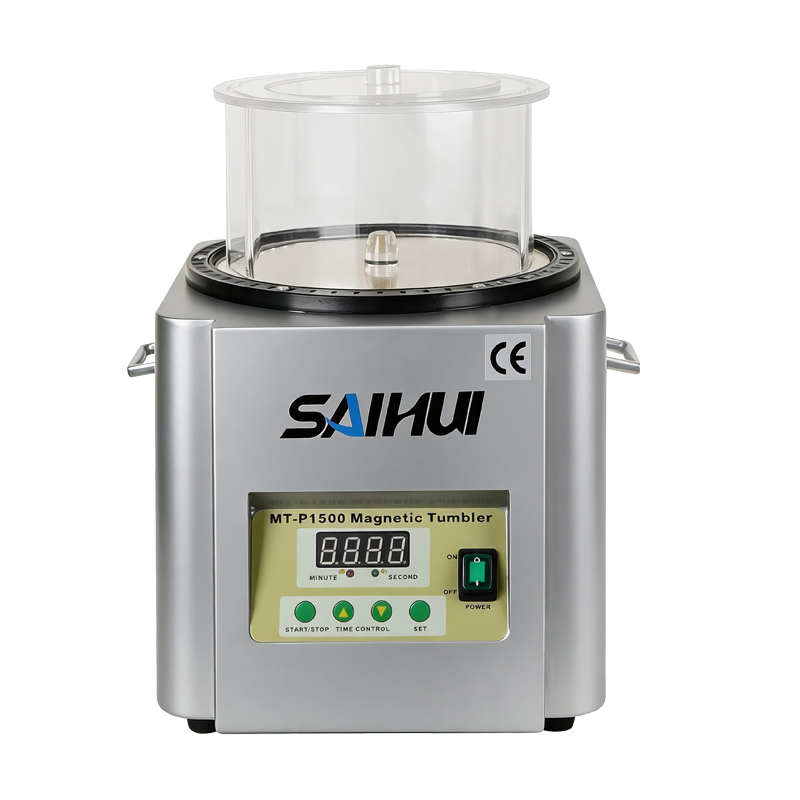
The second wear mechanism is media-to-media contact within the processing chamber. In vibratory finishing, media particles oscillate against each other continuously, creating inter-media friction that erodes binder surfaces and fractures abrasive grains even in areas not contacting jewelry workpieces. In barrel tumbling, the cascading motion creates impact forces between media particles that accelerate fragmentation, particularly for brittle ceramic media. In magnetic polishing, the stainless steel micro-pins collide at high frequency, but their material hardness and semi-permanent design result in near-zero wear under normal operating conditions—making magnetic pins the most wear-resistant media type available.
The critical insight: both wear mechanisms are always active simultaneously, and total media wear rate equals the sum of workpiece cutting wear plus inter-media friction wear. Reducing either component reduces total consumption. Inter-media friction wear can be reduced without affecting surface quality on jewelry—this represents the primary cost-reduction opportunity.
Media wear affects operating costs through both direct consumption expenses and indirect quality and efficiency impacts.
Direct media replacement cost is calculated as: media consumption rate (kg/hour) × media unit cost ($/kg) × operating hours. For a typical vibratory finishing operation processing gold jewelry with ceramic media, consumption rates range from 0.5% to 2.5% of media volume per hour. A machine loaded with 10 kg of media at $2.50/kg, consuming 0.8 kg/hour, incurs $2.00/hour in media cost. At 8 hours daily operation, this accumulates to $16/day or approximately $5,800/year—a significant expense that warrants systematic reduction effort.
Excessive media wear degrades process consistency beyond the direct cost of media replacement. As media size decreases through wear, the machine's kinematic behavior changes: smaller media particles pack more densely, move more slowly within the processing chamber, and deliver reduced cutting energy per contact cycle. This degradation manifests in extended cycle times (because worn media processes surfaces less efficiently), inconsistent edge quality across batches, and surface quality that falls below validated specifications without any visible warning during operation. The jewelry pieces reach inspection with residual burrs, uneven polish, or surface defects that require reprocessing—adding additional cycle time, labor, and media cost to correct. These indirect costs often exceed the direct media replacement cost, making wear management a quality investment rather than merely a cost-reduction exercise.
Systematic diagnosis of excessive media wear addresses six root causes, each with specific corrective actions.
Excessive parts-to-media loading ratio increases inter-media contact pressure, accelerating friction wear. The recommended ratio for jewelry finishing is 1:3 to 1:5 parts-to-media by volume, depending on part geometry, weight, and fragility. Overloading beyond this ratio—common when operators attempt to maximize per-batch throughput—increases media wear disproportionately because the additional parts reduce media's freedom of movement, creating concentrated contact zones with high local friction. Corrective action: verify and maintain loading ratio within recommended ranges; if throughput requires higher part quantities, increase chamber capacity rather than overload existing machines.
Higher vibration amplitude and frequency increase the kinetic energy of media-particle collisions, accelerating fragmentation and inter-media wear. While higher speeds may reduce cycle time, the media wear acceleration often offsets the time savings through increased consumption cost. A 10–15% amplitude reduction typically reduces media wear by 15–25% while maintaining effective surface modification—because the lower-impact contact produces more controlled abrasion rather than brute-force impact. Corrective action: reduce amplitude incrementally and verify surface quality remains within specification; identify the minimum amplitude that achieves target finish quality.
Compound concentration directly lubricates media-part and media-media contact, reducing friction wear. Insufficient compound concentration creates dry-contact conditions where media particles abrade each other without lubrication—accelerating wear dramatically. Excessive concentration can soften certain media types (particularly low-density plastic media) through chemical attack on the binder, also accelerating wear but through a different mechanism. Corrective action: measure compound concentration against manufacturer technical data sheets; verify concentration matches the workpiece metal and media type; implement automated compound dosing to eliminate manual addition variability.
In wet polishing operations, water flow flushes removed material particles and debris from the processing chamber. Insufficient water flow allows debris accumulation, creating abrasive slurry that accelerates both media-part and media-media wear beyond normal rates. The correct water flow rate maintains continuous chamber flushing without diluting compound below its functional concentration range. Corrective action: increase water flow until discharge remains visibly clear of heavy debris; monitor compound concentration in recirculation systems to prevent over-dilution.
Using aggressive media on soft metals creates dual waste: the media wears faster because it cuts more material than necessary, and the jewelry surface may be over-processed. Processing gold or aluminum with ceramic media (designed for steel and hard metals) creates excessive cutting pressure that fractures ceramic abrasive grains rapidly. The correct pairing is plastic media for soft metals (gold, silver, aluminum) and ceramic media for hard metals (platinum, stainless steel). Corrective action: review media type against workpiece metal hardness; test alternative media types on sample batches to verify improved wear rates and acceptable surface quality.
Running polishing cycles longer than necessary to achieve target surface quality continues media wear without incremental surface improvement. After jewelry pieces reach their target finish specification, additional processing time contributes only to media consumption—the media continues wearing against both workpiece surfaces (now polished and resistant to further modification) and other media particles. Corrective action: establish validated cycle times through process development testing; stop cycles when target surface quality is achieved rather than running to arbitrary time durations.
Reducing media wear and operating costs requires a systematic, sequential approach—changing one variable at a time and verifying results before proceeding to the next adjustment.
Before making any adjustments, measure current media consumption rate by weighing the media load before and after processing cycles. Calculate consumption in kg/hour and compare against typical benchmarks for your media type and machine configuration. This baseline provides the reference point for evaluating all subsequent optimization efforts.
Confirm parts-to-media ratio falls within the 1:3 to 1:5 recommended range. If current loading exceeds this ratio, reduce part quantity per batch and measure the effect on media consumption. This adjustment requires no capital investment and often produces the most immediate wear reduction.
Verify compound type matches workpiece material, concentration matches manufacturer specifications, and addition rate maintains consistent concentration throughout the cycle. If manual compound addition produces variable results, evaluate automated compound dosing systems—an investment that pays back rapidly in both media savings and finish consistency improvement.
Reduce vibration amplitude by 10–15% from current settings and process sample batches. Measure surface quality against target specifications. If quality remains acceptable, maintain the reduced amplitude. If quality declines, incrementally increase amplitude until target quality is restored, then hold at that minimum-effective setting.
For soft metal processing (gold, silver), test plastic media against current ceramic media on sample batches. Measure media consumption rate, surface quality, and cycle time for each option. Plastic media typically reduces consumption by 30–50% on soft metals while providing adequate surface modification. For hard metals (platinum), test high-density ceramic media or steel media alternatives that offer improved wear resistance with equivalent or superior cutting performance.
For operations currently using barrel tumblers with high media consumption, evaluate transition to vibratory finishing or magnetic polishing. Vibratory machines reduce media wear through gentler contact mechanics. Magnetic polishing machines use semi-permanent stainless steel pins with near-zero consumption—the most dramatic media cost reduction available. The capital investment for machine transition is offset by the ongoing media cost savings, and the payback period can be calculated precisely using baseline consumption data.
The true value of media wear optimization extends beyond individual batch savings to cumulative annual cost reduction. A practical cost model illustrates this impact.
Consider a jewelry workshop operating a vibratory finishing machine 8 hours per day, 250 days per year, with current media consumption of 0.8 kg/hour at $2.50/kg. Current annual media cost: 0.8 × 2.50 × 8 × 250 = $5,000. Through the optimization steps described above, reducing consumption to 0.5 kg/hour (a 37.5% reduction achievable through compound optimization, amplitude reduction, and loading ratio correction) produces annual cost: 0.5 × 2.50 × 8 × 250 = $3,125. Annual savings: $1,875—on a single machine. For operations running multiple machines, the savings multiply proportionally. Combined with the indirect quality improvements (reduced reprocessing, consistent finish quality, validated cycle times), the total operational benefit exceeds the direct media cost savings significantly.
Reducing polishing media wear and operating costs is not an abstract optimization goal but a structured engineering discipline with measurable, predictable outcomes. The six root causes of excessive media wear—overloading, excessive speed, incorrect compound, inadequate water flow, media-material incompatibility, and extended cycle times—each have specific diagnostic indicators and corrective actions. By establishing a consumption baseline, systematically addressing each root cause, and validating surface quality at each step, jewelry manufacturers can reduce media consumption by 30–50% while maintaining or improving finish quality. The cumulative annual savings on a single jewelry polishing machine can reach $1,500–$3,000, with proportional savings on multi-machine operations. For workshops seeking the most dramatic reduction, transitioning from barrel or vibratory finishing to magnetic polishing with semi-permanent pins eliminates media consumption almost entirely—a capital investment decision that pays back through ongoing operating cost elimination. Yihui Casting provides jewelry polishing machines with compound dosing systems, variable speed controls, and magnetic polishing configurations that enable systematic media wear optimization. Contact Yihui Casting's technical team for guidance on implementing media cost-reduction strategies tailored to your specific production parameters.
 online service
Scan to wechat :