Selecting a jewelry polishing machine without accounting for batch size and production volume is one of the most common and costly equipment selection errors in jewelry manufacturing. A machine perfectly suited for a workshop processing 50 rings per day becomes a production bottleneck when volume increases to 500. Conversely, investing in a high-capacity industrial polishing system for a custom jeweler producing 10 unique pieces per week creates unnecessary capital expenditure and operational complexity. The relationship between production volume and machine specifications—capacity, throughput rate, automation level, and process flexibility—must be systematically evaluated to ensure the selected equipment delivers both current production efficiency and appropriate scalability for future growth.
Before evaluating machine specifications, jewelry manufacturers must clearly define their production volume category, as each category has distinct equipment requirements.
Custom jewelry workshops and independent designers producing unique or semi-unique pieces operate in the low-volume category. Production batches are small—often 5 to 20 pieces per cycle—with high product mix variability (different metals, shapes, sizes, and finish requirements within the same production period). The primary equipment priorities for this category are flexibility, small-batch efficiency, and minimal setup time between different product types. High throughput capacity is unnecessary, and over-investment in large-capacity machines wastes capital and workshop space.
Professional jewelry workshops with established product lines and semi-automated casting operations fall into the medium-volume category. Production batches range from 50 to 200 pieces per cycle, with moderate product mix variability—several standard product types processed in rotation. Equipment priorities balance throughput capacity with process flexibility, enabling efficient batch processing of standard products while accommodating custom or seasonal pieces. This is the most common production category for established jewelry manufacturers.
Industrial jewelry manufacturers producing large quantities of standardized products—wedding bands, chain links, standard earring components—operate in the high-volume category. Production batches are large (200–1000+ pieces per cycle), product mix variability is low, and equipment priorities emphasize maximum throughput, consistent batch uniformity, and labor-minimizing automation. Machine downtime is costly at this volume, so reliability, serviceability, and redundancy (multiple machines or backup systems) are critical considerations.
The processing chamber capacity of a jewelry polishing machine directly determines how many jewelry pieces can be processed in a single cycle. Selecting a machine with appropriate capacity for your batch sizes ensures efficient loading without overfilling (which reduces finish quality) or underfilling (which wastes cycle time and compound).
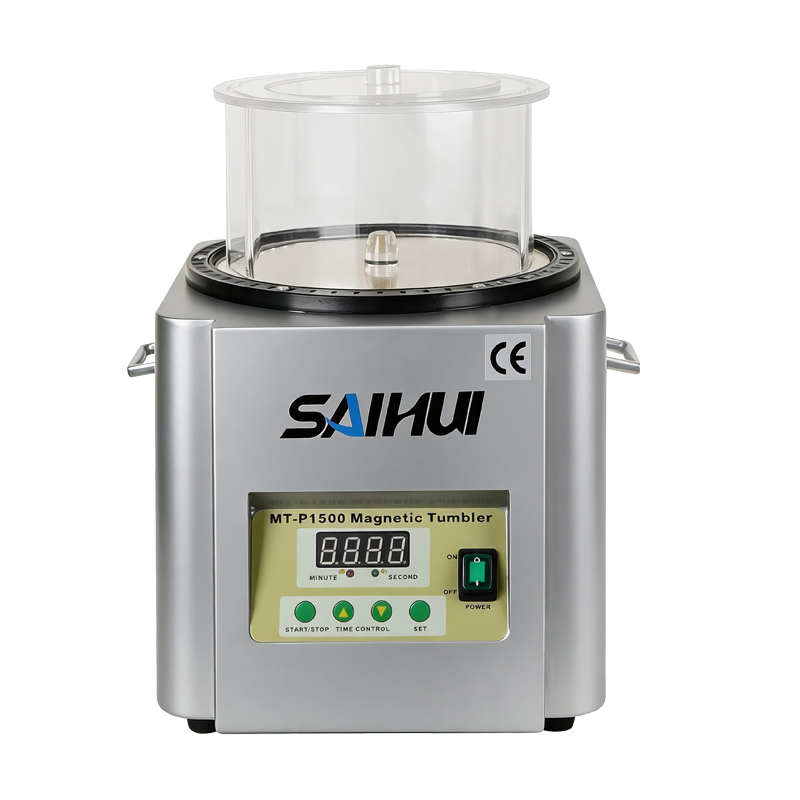
Small-capacity vibratory bowls, barrel tumblers, and magnetic polishing chambers are designed for low-volume custom production. A 5-liter vibratory bowl can process approximately 30–50 small rings per cycle, or 10–20 larger pieces such as bracelets or pendants. Small machines offer rapid cycle start-up, easy product changeover, and minimal compound consumption per batch. Their primary limitation is throughput: even with short cycle times, the small per-batch quantity means total daily production is limited by the number of cycles that can be completed within working hours. Magnetic polishing machines in this capacity range offer the fastest cycle times (5–15 minutes), enabling multiple small batches per hour—a significant throughput advantage for custom workshops processing varied product types.
Medium-capacity machines suit the medium-volume workshop category. A 20-liter vibratory tub processes approximately 150–300 small rings or 50–100 larger pieces per cycle. This capacity range balances per-batch quantity with manageable loading and unloading effort. Medium machines typically include variable speed controls, compound recirculation systems, and semi-automated drainage—all features that improve process consistency and reduce operator intervention compared to small machines. The cycle time for medium-capacity machines (45–120 minutes for vibratory, 30–60 minutes for centrifugal) means 3–6 batches can be completed per shift, providing adequate daily throughput for workshop-scale production when combined with appropriate vacuum pressure casting machine output.
Large-capacity machines serve high-volume industrial production. A 50-liter vibratory tub processes 400–800 small rings per cycle; 100-liter systems handle 1000+ pieces. Large machines feature industrial-grade motors (3–5 HP), heavy-duty vibration isolation, automated compound dosing, and integrated part-media separation systems. Their throughput capacity—when combined with 2–4 cycle completions per shift—delivers daily production quantities in the thousands. The primary trade-off is reduced flexibility: large machines require more time for product changeover, consume more compound and media per cycle regardless of actual batch size, and occupy significantly more workshop floor space. For high-volume operations with standardized product lines, these trade-offs are acceptable because the throughput gain outweighs flexibility loss.
The per-hour production rate of a polishing operation depends on both chamber capacity and cycle time. Understanding this relationship enables precise throughput calculations for production planning.
Effective throughput (pieces per hour) = (chamber capacity / cycle time + changeover time) × loading efficiency. For example, a 20-liter vibratory machine processing 200 rings per cycle with a 90-minute cycle time and 15-minute changeover (loading, unloading, media separation, cleaning) produces: 200 / 105 minutes × 60 = approximately 114 rings per hour. A magnetic polishing machine processing 30 rings per cycle with a 10-minute cycle time and 5-minute changeover produces: 30 / 15 minutes × 60 = approximately 120 rings per hour. Despite the magnetic machine's smaller per-batch capacity, its dramatically shorter cycle time produces equivalent or higher per-hour throughput—an important insight for low and medium-volume operations where cycle time is the throughput bottleneck rather than chamber capacity.
Magnetic polishing: 5–15 minutes per cycle regardless of metal type (the micro-pin mechanism adjusts naturally to surface hardness). Vibratory finishing: 30–120 minutes depending on metal hardness (gold: 30–60 min, silver: 45–90 min, platinum: 120–240 min). Barrel tumbling: 2–6 hours depending on metal and finish requirements. Centrifugal disc finishing: 15–45 minutes for moderate metals, 30–60 minutes for platinum. The cycle time difference between machine types becomes the dominant throughput factor at low and medium batch sizes, while chamber capacity dominates at high batch sizes.
Production volume directly determines the labor cost impact of polishing operations and the economic justification for automation investment.
At low production volumes (1–50 pieces per day), manual loading, unloading, and process monitoring are practical because the total labor time required is modest—typically 30–60 minutes per day for polishing operations. The labor cost of manual handling at this volume does not justify investment in automated loading, separation, or compound management systems. Small-capacity machines with manual controls are appropriate for this category, and operator skill in adjusting cycle parameters for different product types is more valuable than automation.
At medium volumes (50–500 pieces per day), semi-automated features become economically justified. Automated compound dosing eliminates the inconsistency and labor time of manual compound addition—particularly important for multi-batch daily production where compound concentration drift between batches causes finish variability. Automated drainage and part-media separation screens reduce unloading time from 15–20 minutes to 5–10 minutes per batch. Variable speed controls with pre-set programs enable rapid product changeover without manual parameter recalibration. The cumulative labor savings from these semi-automated features at medium volumes typically range from 30–50% compared to fully manual operations, providing clear return on the additional equipment investment.
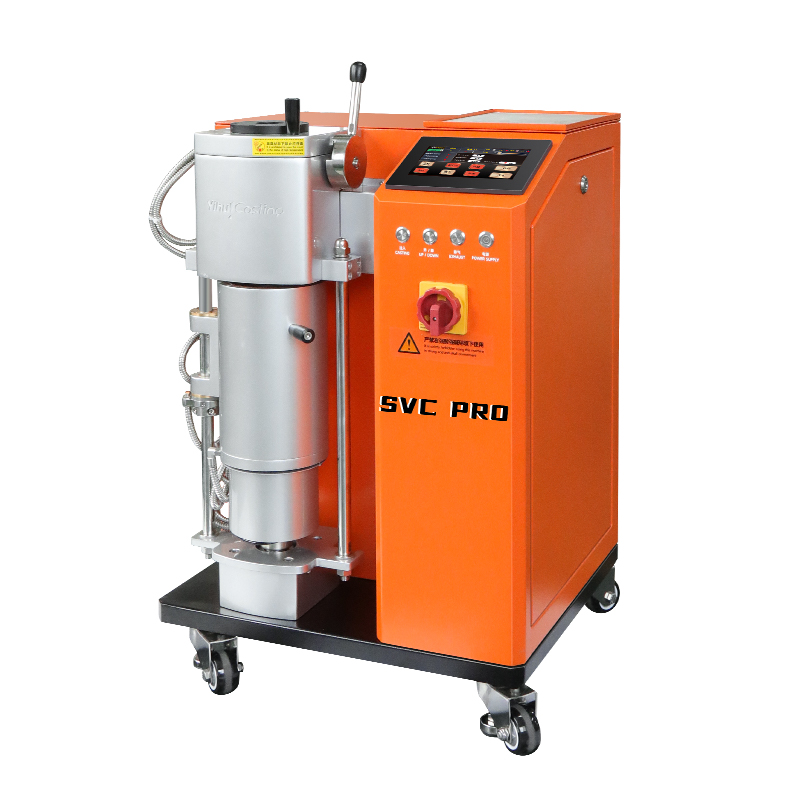
At high volumes (500+ pieces per day), fully automated polishing systems—including robotic loading, continuous-process vibratory machines with in-line part feeding, and automated quality inspection—deliver the maximum labor efficiency. Industrial-scale operations running multiple polishing machines across shifts require automation to maintain consistent process parameters without operator-dependent variability. The labor savings at high volume justify substantial automation investment: a fully automated vibratory finishing line with continuous feed can operate with minimal operator supervision, reducing polishing labor to quality monitoring and periodic media replenishment. For high-volume manufacturers, the polishing operation should integrate seamlessly with upstream jewelry melting furnace and casting production and downstream inspection and packaging.
Jewelry manufacturers selecting polishing equipment must consider not only current production volume but anticipated growth trajectory. Several scalability strategies address volume increase without requiring complete equipment replacement.
Vibratory finishing systems with modular tub designs allow capacity expansion by adding processing tubs to an existing vibration drive platform. This approach doubles or triples throughput capacity without purchasing a complete new machine. Manufacturers anticipating volume growth within 2–3 years should prioritize machines with modular expansion capability over fixed-capacity alternatives.
For operations with high product mix variability and anticipated volume growth, purchasing two medium-capacity machines rather than one large-capacity machine provides better scalability. Two machines can process different product types simultaneously (different metals, different media, different compounds), eliminate cross-contamination between product lines, and provide production redundancy—if one machine requires maintenance, the other maintains partial production capacity. The total investment for two medium machines is comparable to one large machine, but the operational flexibility and scalability advantages are significant.
As production volume increases, the optimal machine type may change. Custom workshops producing 10–50 pieces per day typically benefit most from magnetic polishing machines (fast cycle times, small batches, excellent detail preservation). When volume increases to 200+ pieces per day of standardized products, vibratory finishing machines with larger capacity become more efficient per-piece. At 500+ pieces per day, centrifugal disc or large vibratory systems with automation deliver the best throughput-cost ratio. Planning for machine type transitions at volume thresholds—rather than forcing a low-volume machine into high-volume production or vice versa—ensures continuous operational efficiency.
Batch size and production volume are the primary determinants of jewelry polishing machine selection, influencing capacity requirements, throughput calculations, automation investment justification, and scalability planning. Low-volume custom production demands small-capacity, flexible machines with fast cycle times—magnetic polishing systems are often optimal. Medium-volume workshops need moderate capacity with semi-automated features—vibratory finishing machines with compound dosing and variable speed controls provide the best balance. High-volume industrial production requires large-capacity, fully automated systems that maximize throughput with minimal labor intervention. By matching machine specifications to current production volume and anticipated growth, jewelry manufacturers avoid both the under-capacity bottleneck and the over-investment waste that result from volume-unaware equipment selection. Yihui Casting offers polishing machines across all capacity ranges—from compact magnetic polishers for custom workshops to industrial vibratory systems for high-volume production—enabling jewelry manufacturers to select equipment precisely matched to their production requirements. Browse Yihui Casting's polishing machine catalog to find the capacity and automation configuration that fits your batch size and volume category.
 online service
Scan to wechat :