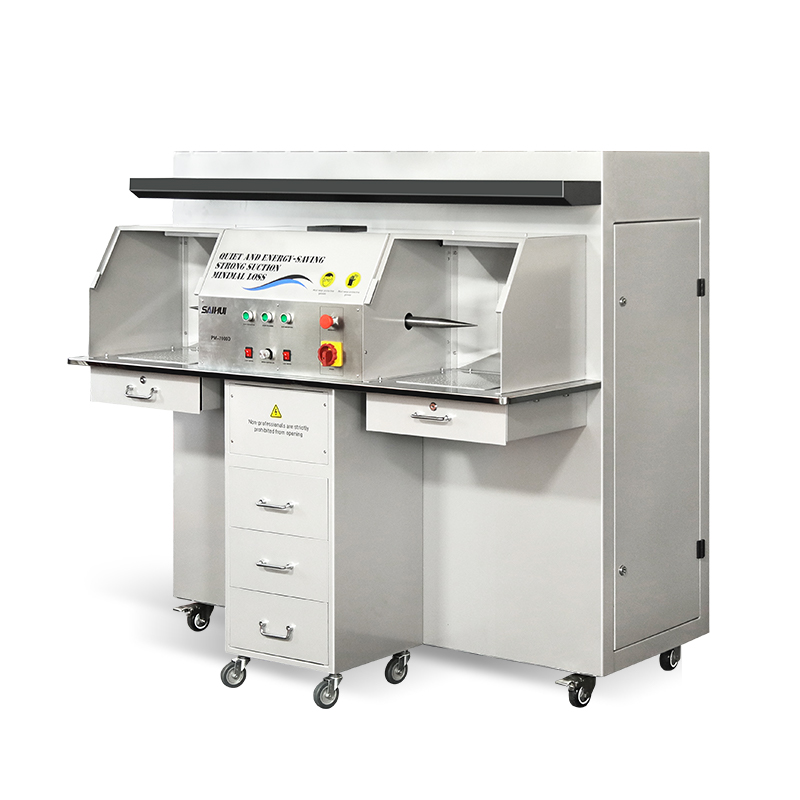
The choice between wet and dry polishing methods is a fundamental process decision that affects every aspect of jewelry finishing—from the jewelry polishing machine configuration to the compound delivery system, media behavior, surface outcome, and post-processing requirements. While both methods achieve surface improvement through media-part contact, they operate on entirely different process mechanics, produce distinct surface characteristics, and require different equipment infrastructure. For jewelry manufacturers evaluating their finishing operations, understanding the technical differences between wet and dry polishing is essential for selecting the method that delivers the best results for their specific product mix and production environment.
Wet and dry polishing differ not only in the presence or absence of liquid but in how energy transfers from media to jewelry surfaces, how debris is managed, and how the compound chemistry interacts with the workpiece.
In wet polishing, parts and media are processed inside a jewelry polishing machine with a continuous supply of liquid compound—typically a water-based solution containing surfactants, abrasive activators, corrosion inhibitors, and burnishing agents. The liquid serves three simultaneous functions: it lubricates media-part contact to reduce impact intensity and prevent surface denting; it suspends removed material particles to prevent re-embedding into the polished surface; and it chemically contributes to surface modification through controlled etching, tarnish dissolution, or oxide removal. The liquid also carries heat away from contact points, preventing friction-induced temperature rise that could affect soft metals like gold. Wet polishing is the dominant method in professional jewelry mass finishing, representing approximately 80% of production applications.
Dry polishing processes parts and media without any liquid addition. The media—typically walnut shells, corn cob granules, wood pegs, or pre-impregnated abrasive granules—contacts jewelry surfaces directly, with all surface modification achieved through mechanical friction alone. There is no chemical contribution to surface improvement, no liquid suspension of debris, and no heat management through evaporative cooling. Removed material particles remain in the processing chamber and must be managed through media replacement or dust collection systems. Dry polishing excels in applications where moisture is undesirable—processing moisture-sensitive materials, achieving specific surface textures, or preparing parts for immediate coating or plating without a drying step.
Wet and dry polishing require different machine configurations, drainage systems, compound delivery infrastructure, and environmental controls. Understanding these differences helps jewelry workshops plan equipment investments and facility layout.
Wet polishing machines require integrated drainage systems with compound recirculation or flow-through configurations. Vibratory machines designed for wet operation include drain ports, compound settling chambers, and recirculation pumps that maintain consistent liquid flow through the processing chamber. Barrel tumblers for wet use feature sealed barrels with drain valves for compound and water management. These drainage components add cost and maintenance requirements but are essential for controlling compound concentration, water flow rate, and debris removal during processing.
Dry polishing machines have simpler construction without drainage infrastructure. The processing chamber is a sealed or semi-sealed container that retains all media and debris. However, dry processing generates dust and airborne particles that require dust collection systems—typically integrated exhaust fans or external dust extraction units connected to the machine. Without proper dust collection, dry polishing operations create workshop air quality issues and potential respiratory hazards for operators. The dust collection requirement offsets much of the construction simplicity advantage of dry machines, and the total equipment cost for dry polishing with proper environmental controls is comparable to wet polishing systems.
Wet polishing uses compound delivery systems that range from manual addition (pouring compound into the processing chamber) to automated dosing systems that maintain precise concentration levels throughout extended cycle times. Automated compound delivery—available on advanced vibratory finishing machines—eliminates the concentration variability that causes inconsistent finishes in manual compound management. Compound concentration directly affects cutting rate, surface protection, and media lubrication, making automated delivery a significant quality and cost advantage for production environments.
Dry polishing eliminates compound delivery entirely when using pre-impregnated media (media manufactured with embedded abrasive and polishing agents). However, some dry polishing applications use dry compound addition—powdered polishing agents added directly to the media bed—which requires manual metering and produces less consistent distribution than liquid compound systems. The absence of liquid compound chemistry in dry polishing means all surface improvement must come from media mechanics alone, limiting the range of achievable surface outcomes.
Wet polishing supports all media types: ceramic, plastic, steel, porcelain, and natural stone media all function effectively in wet environments. The liquid compound lubricates media-part contact, reduces media wear, and prevents media fragmentation under processing loads. This broad compatibility gives wet polishing greater flexibility for different jewelry materials and finish requirements.
Dry polishing is limited to media that functions without liquid lubrication. Walnut shells, corn cob, and pre-impregnated polishing granules are the primary dry media options for jewelry. Ceramic and plastic media can be used dry for aggressive deburring but generate excessive dust, rapid media breakdown, and surface quality issues without liquid lubrication. Steel media is incompatible with dry processing because it requires liquid compound to prevent corrosion and maintain burnishing action. This narrower media compatibility restricts dry polishing's application range, particularly for heavy deburring and burnishing operations.
The surface finish each method produces differs in smoothness, brightness, cleanliness, and uniformity—factors that directly affect jewelry quality perception and downstream processing requirements.
Wet polishing consistently produces smoother surfaces with lower Ra values than dry polishing for equivalent cycle times and media types. The liquid compound lubricates contact points, allowing media to glide across surfaces rather than impact them, creating smoother, more consistent surface modification. Wet polishing achieves mirror-quality finishes on flat gold and silver surfaces (Ra below 0.1 µm) with appropriate media and compound selection. Dry polishing produces slightly higher Ra values for equivalent processing—typically 0.2–0.5 µm higher than wet processing with the same media—because the direct mechanical contact creates micro-impact patterns on the surface. For jewelry where true mirror finish is required—high-end gold rings, platinum bracelets, polished silver pendants—wet polishing delivers the superior surface result.
Wet polishing produces brighter, more reflective surfaces because the compound chemistry actively removes oxide films and tarnish layers that reduce reflectivity. On silver jewelry, wet polishing with tarnish-active compounds produces a bright, white surface reflectivity that dry polishing cannot match without post-processing chemical treatment. On gold, wet polishing maintains the warm, rich luster by preventing oxide formation during processing. Dry polishing achieves moderate brightness through mechanical burnishing but cannot chemically remove tarnish or oxide layers, resulting in surfaces that may appear slightly dull compared to wet-processed equivalents.
Wet polishing produces cleaner surfaces because the liquid continuously flushes removed material from the processing chamber. Parts emerge from wet processing rinsed and relatively clean, requiring only a brief water rinse and drying step before inspection or further processing. Dry polishing leaves debris particles, dust, and media residue adhering to jewelry surfaces, requiring thorough cleaning—typically ultrasonic cleaning with detergent—before the surface can be inspected or processed further. This additional cleaning step adds time, labor, and equipment cost that must be factored into the total process cost comparison. For jewelry workshops that already own jewelry casting equipment with integrated ultrasonic cleaning capability, this additional step may be straightforward; for others, it represents a significant operational burden.
Both methods can preserve fine details when properly configured, but wet polishing offers better edge control due to its lubricated, lower-impact contact mode. The liquid compound reduces the peak contact force between media and jewelry surfaces, preventing aggressive edge rounding on prongs, bezels, and engraved details. Dry polishing's direct mechanical contact produces slightly more aggressive edge modification, which may be undesirable for jewelry requiring crisp, well-defined edges. However, for applications where intentional edge softening is desired—producing a comfortable, rounded feel on wedding band inner edges—dry polishing's more aggressive contact can be advantageous.
Despite wet polishing's general superiority for jewelry applications, specific scenarios make dry polishing the better method.
Jewelry pieces requiring immediate electroplating, PVD coating, or adhesive setting after polishing benefit from dry processing because there is no moisture to remove before the coating application. Wet-polished pieces must be thoroughly dried before plating—any residual moisture causes coating defects, adhesion failures, or blistering. For production lines where polishing immediately precedes plating, dry polishing eliminates the drying step and its associated time and energy cost.
Dry polishing produces a subtly different surface texture than wet polishing—the mechanical-only contact creates a fine, directional micro-pattern that some jewelry designers intentionally specify for satin, brushed, or matte finishes. Walnut shell media in dry processing produces a soft satin texture on gold and silver that wet polishing with equivalent media cannot replicate precisely because the liquid compound modifies the contact mechanics. For jewelry where a specific tactile surface texture is a design requirement rather than maximum smoothness, dry polishing may deliver the more accurate result.
In production environments where wastewater discharge regulations are strict or compound disposal costs are high, dry polishing eliminates liquid waste generation entirely. This advantage is significant for workshops in regions with stringent environmental compliance requirements or for operations that lack wastewater treatment infrastructure. The trade-off is increased air quality management responsibility through dust collection, but dry polishing's zero-liquid-waste profile simplifies environmental compliance in specific regulatory contexts.
Total operating costs differ between wet and dry polishing across several cost categories. Wet polishing incurs ongoing compound, water, and wastewater management costs but produces higher-value surface finishes with lower post-processing requirements. Dry polishing eliminates compound and water costs but generates media replacement costs (dry media wears faster without lubrication), dust collection maintenance costs, and additional cleaning costs for post-processing part preparation. Media consumption in dry processing is typically 2–3 times higher than wet processing with equivalent media types, because the liquid lubrication in wet polishing significantly extends media life. For most jewelry production operations processing precious metals where finish quality directly impacts product value, wet polishing's higher surface quality offset its additional operational costs. For applications where finish quality requirements are moderate and environmental simplicity is prioritized, dry polishing provides a cost-effective alternative.
The wet vs dry polishing decision for jewelry is not a simple binary choice but a process engineering decision that depends on material type, finish specification, production workflow, environmental constraints, and total cost evaluation. Wet polishing delivers superior surface smoothness, brightness, and cleanliness for the majority of precious metal jewelry applications and should be the default method for professional finishing operations. Dry polishing serves specific niche applications where moisture elimination, texture control, or environmental simplicity are primary requirements. Many professional jewelry workshops operate both wet and dry jewelry polishing machines to address the full range of finishing requirements across their product lines. Yihui Casting provides both wet and dry polishing machine configurations, enabling jewelry manufacturers to select the method that matches each product's finish requirements. Consult Yihui Casting's polishing equipment specialists to determine the optimal wet or dry configuration for your specific jewelry production needs.
 online service
Scan to wechat :