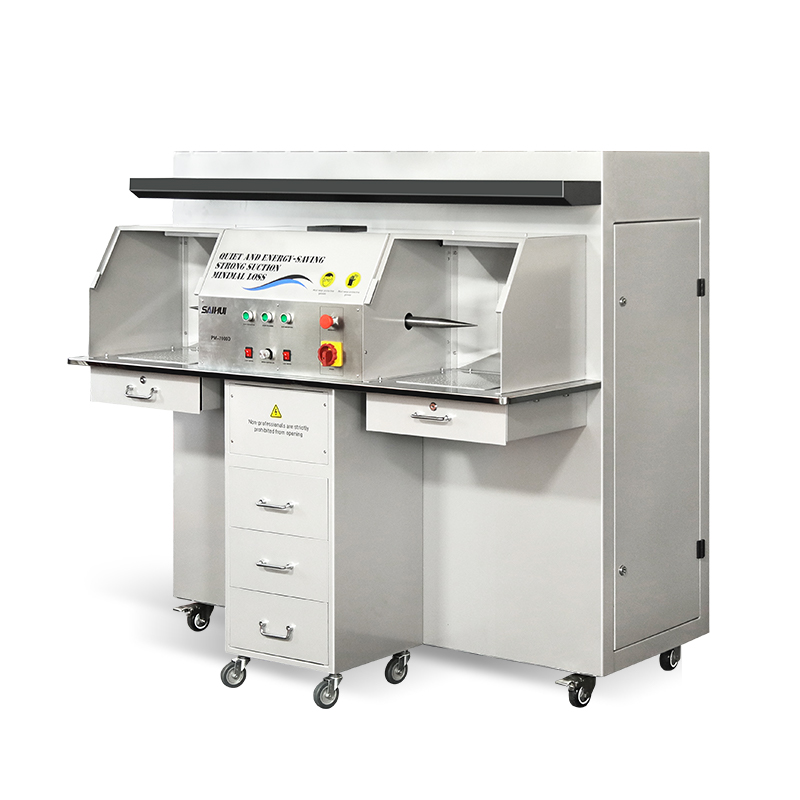
The finish quality of gold, silver, and platinum jewelry depends not merely on owning a jewelry polishing machine but on operating it with the correct speed settings and media combinations for each specific precious metal. Gold's relative softness, silver's tendency toward tarnish-related surface issues, and platinum's extreme hardness each demand distinct process parameters. Using the same speed and media across all three metals produces inconsistent results—over-processing on soft gold, under-processing on hard platinum, and surface contamination on reactive silver. This guide provides a systematic approach to selecting machine speed and polishing media for each precious metal, ensuring optimal finish quality while minimizing cycle time and media waste.
The three precious metals used in fine jewelry differ dramatically in their physical and chemical properties, and these differences directly determine the polishing parameters required.
Pure gold (24K) has a Vickers hardness of approximately 20 HV, making it one of the softest metals used in jewelry. Even alloyed gold (14K at approximately 150–170 HV, 18K at approximately 130–160 HV) remains significantly softer than most polishing media. This softness means gold is susceptible to over-processing: excessive speed or aggressive media can remove too much material, round edges beyond acceptable tolerances, and blur engraved details or milgrain patterns. Gold's ductility also means it can develop surface smearing under high-contact conditions, where material displaces rather than removes, creating a polished surface that hides rather than eliminates underlying imperfections.
Sterling silver (92.5% Ag, 7.5% Cu) has a hardness of approximately 60–80 HV, placing it between gold and platinum in terms of material removal resistance. Silver's primary challenge is not hardness but tarnish—silver reacts with atmospheric sulfur to form silver sulfide (Ag₂S) surface films that appear as dark discoloration. Polishing silver requires not only surface smoothing but also chemical tarnish removal. This dual requirement means compound selection is as important as media selection for silver polishing. Additionally, silver's moderate hardness makes it vulnerable to both under-processing (insufficient deburring) and over-processing (edge rounding) if speed and media are not carefully matched.
Platinum alloys used in jewelry (commonly Pt950 with hardness of approximately 120–300 HV depending on alloy composition) present the opposite challenge to gold. Platinum's extreme hardness means material removal rates are very low—polishing requires higher energy input (faster machine speeds, more aggressive media) and longer cycle times to achieve comparable surface improvement. Platinum also tends to work-harden during processing, meaning surface hardness increases as polishing progresses, further reducing removal rates in prolonged cycles. The high cost of platinum adds economic pressure to minimize material loss, making efficient process parameter selection critical.
Jewelry polishing machines control surface contact intensity through three speed-related parameters: vibration frequency (for vibratory and magnetic machines), oscillation amplitude, and rotational RPM (for barrel tumblers). Adjusting these parameters based on metal hardness is the first step toward optimized finishing.
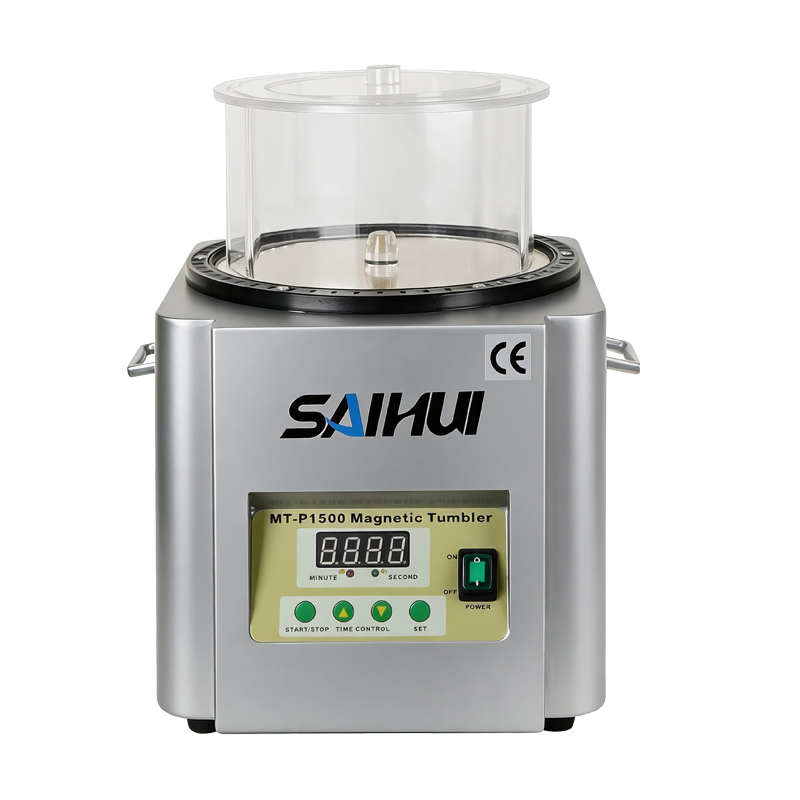
For gold jewelry, lower machine speeds produce the best results. In vibratory finishing, frequencies of 1000–1500 vibrations per minute with reduced amplitude (2–4 mm) provide sufficient contact energy for surface smoothing without excessive material removal. In barrel tumbling, RPM should be set to the minimum that maintains consistent tumbling action—typically 20–30 RPM for small-barrel machines processing gold. Magnetic polishing machines inherently operate with minimal macroscopic force, making them safe for gold at standard frequencies, though cycle times should be limited to 5–10 minutes to prevent over-processing. The guiding principle for gold: reduce speed until the minimum effective material removal rate is achieved, then fine-tune compound concentration to control the chemical contribution to surface improvement.
Silver requires moderate machine speeds that balance mechanical surface improvement with chemical tarnish removal. Vibratory machines should operate at 1500–2500 vibrations per minute with standard amplitude (4–6 mm). Barrel tumblers processing silver can run at 30–45 RPM. The moderate speed provides sufficient contact energy to smooth surface irregularities while allowing the tarnish-removing compound to work effectively. Too fast a speed on silver can create friction-induced heating that promotes further tarnish formation during processing—an counterproductive outcome that requires additional post-polish cleaning steps.
Platinum demands the highest machine speeds to achieve practical material removal rates. Vibratory machines should operate at 2500–3500 vibrations per minute with maximum amplitude (6–8 mm). Barrel tumblers can run at 40–60 RPM. Magnetic polishing machines should use the maximum pin density and magnetic field intensity available. Centrifugal disc finishing—which combines high rotational speed with centrifugal force amplification—is particularly effective for platinum, achieving removal rates 5–10 times faster than standard vibratory processing. The extended cycle times required for platinum (2–4 hours in vibratory systems, 30–60 minutes in centrifugal systems) reflect the metal's resistance to surface modification.
Polishing media determines the contact geometry, cutting intensity, and surface pattern transferred to jewelry. Selecting media based on metal characteristics is as critical as speed adjustment.
For gold polishing, plastic (resin-bonded) media is the preferred choice. Plastic media is less aggressive than ceramic media, reducing the risk of over-processing on soft gold surfaces. Shape selection should prioritize media that reaches detailed areas—cone, triangle, and elliptical shapes provide better access to prong gaps and channel interiors than spherical or cylindrical shapes. Media size should be small (3–6 mm) to match the typical dimensions of jewelry components and prevent lodging in tight settings. For pre-finishing stages on rough gold castings, medium-cut plastic media (with aluminum oxide abrasive bonded at 20–30% concentration) provides sufficient deburring power without excessive surface aggressiveness. For final polishing stages, fine-cut or extra-fine plastic media (10–15% abrasive concentration) produces smooth surfaces ready for buffing.
Silver polishing media must serve two functions: mechanical surface smoothing and chemical tarnish removal. Ceramic media with moderate abrasive content works well for the mechanical component, providing sufficient cutting action to smooth silver's moderate hardness surface. However, the compound selection is equally critical—silver-specific polishing compounds containing tarnish inhibitors and mild acid activators (pH 4–6 range) dissolve silver sulfide films while the media mechanically polishes the underlying surface. Media shape for silver should balance surface coverage with access to detail—a mix of spherical media for broad surface contact and shaped media (triangles, stars) for recessed areas provides comprehensive processing. When polishing silver with a jewelry polishing machine, using separate batches for tarnish-removal and final-polishing stages produces the most consistent results.
Platinum requires the most aggressive media options available. High-density ceramic media with 40–60% aluminum oxide abrasive concentration provides the cutting power needed to modify platinum's hard surface. Pre-formed shapes (angle-cut cylinders, tri-stars) deliver concentrated contact points that increase local cutting intensity. Media size can be larger for platinum (6–10 mm) since platinum components are typically more robust and less vulnerable to detail damage. For final polishing stages after aggressive deburring, steel media (stainless steel balls or pins) burnishes platinum surfaces through high-pressure contact without abrasive cutting, producing the dense, mirror-like finish that platinum jewelry demands. Centrifugal disc finishing machines using steel media achieve exceptional platinum polish in 30–45 minutes—far faster than vibratory processes.
Beyond speed and media, compound selection and process configuration complete the parameter set for each metal.
Compound concentration affects both cutting efficiency and surface protection. For gold, use mild compounds at low concentration (1–2% by volume) to avoid chemical over-processing. For silver, moderate concentration (2–3%) with tarnish-active compounds. For platinum, high concentration (3–5%) with aggressive cutting compounds to maximize material removal efficiency. pH management is particularly critical for silver—compound pH below 4 risks etching copper in sterling alloys, while pH above 8 reduces tarnish-removal effectiveness.
Wet processing is standard for all three metals in vibratory and barrel systems. Water flow rates should be adjusted to maintain consistent compound concentration without excessive dilution. Gold benefits from lower water flow (maintaining compound concentration for gentle chemical action), silver requires moderate flow (balancing tarnish removal with compound effectiveness), and platinum needs higher flow (flushing removed hard material particles that could otherwise re-embed in the polished surface). Magnetic polishing operates in liquid solution mode with controlled compound addition, and the flow parameters are typically managed by the machine's integrated system.
Typical cycle times with optimized parameters: gold in vibratory finishing—30–60 minutes; silver—45–90 minutes; platinum—120–240 minutes. Magnetic polishing reduces these times significantly: gold—5–8 minutes; silver—8–12 minutes; platinum—15–30 minutes. Centrifugal disc finishing for platinum—30–60 minutes. Always verify actual surface improvement against target specifications before standardizing cycle times for production.
Effective jewelry polishing requires matching machine speed and media parameters to the specific properties of each precious metal. Gold demands gentle, low-speed processing with soft plastic media to prevent over-processing and detail loss. Silver requires balanced mid-range speeds with tarnish-active compounds and mixed media shapes for dual mechanical-chemical action. Platinum necessitates aggressive, high-speed processing with hard ceramic or steel media to overcome its extreme surface hardness. By systematically adjusting speed, media, compound, and cycle time for each metal, jewelers can achieve consistent, high-quality finishes that maximize both production efficiency and product value. Yihui Casting offers a comprehensive range of jewelry polishing machines with variable speed controls and configurable media compatibility, enabling precise parameter adjustment for gold, silver, and platinum processing. Visit Yihui Casting's polishing equipment catalog to explore machines designed for multi-metal finishing flexibility.
 online service
Scan to wechat :