Selecting the right jewelry polishing machine is one of the most consequential equipment decisions a jewelry manufacturer will make. The finishing stage determines not only the visual appeal of a piece but also its perceived value, structural integrity, and production throughput. Among the three dominant mass-finishing technologies—barrel tumbling, magnetic polishing, and vibratory finishing—each operates on fundamentally different principles, produces distinct surface outcomes, and suits different production contexts. Understanding these differences in depth is essential for jewelers who need to match machine capabilities to their specific product requirements, whether those involve delicate filigree rings, heavy gold chains, or precision-cast platinum components.
Before comparing outcomes, it is important to understand how each machine type creates its polishing effect. The mechanism of action directly determines the finish quality, cycle time, and part compatibility.
Barrel tumbling is the oldest and simplest mass-finishing method. Parts, abrasive media, and a liquid compound are placed inside a rotating barrel. As the barrel spins, the contents cascade over one another in a continuous sliding motion. The weight of the mass above each layer generates substantial contact pressure, producing aggressive friction between parts and media. This mechanism is effective for heavy material removal—stripping oxidation, breaking sharp edges, and smoothing rough casting surfaces—but the uncontrolled tumbling action means parts collide with significant force, which can cause surface indentations, dings, and dimensional distortion on delicate jewelry pieces.
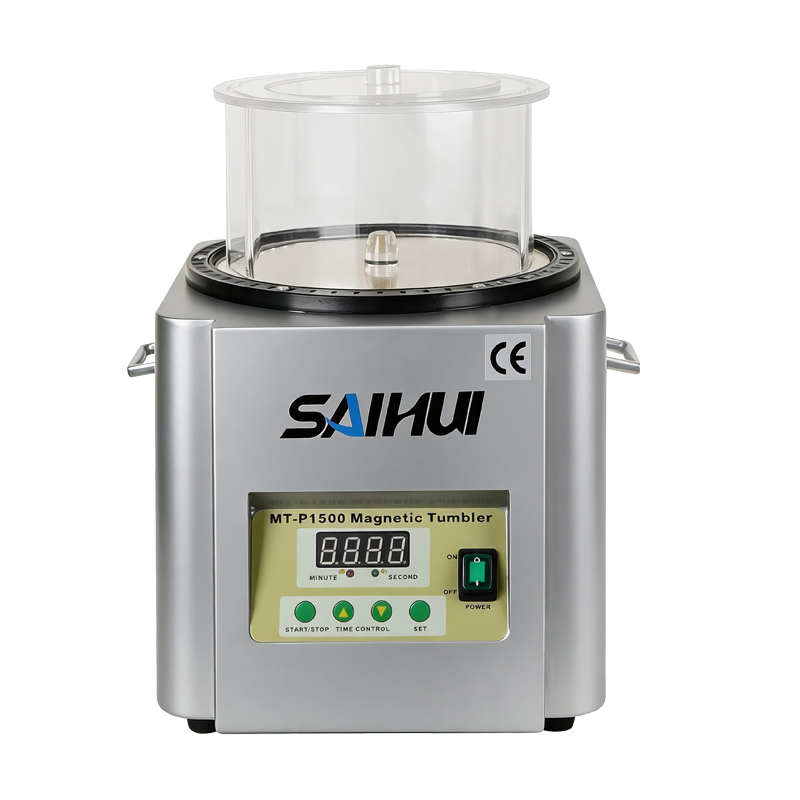
Magnetic polishing machines use high-frequency electromagnetic fields to drive thousands of microscopic stainless steel pins (0.2 mm to 1.2 mm in diameter) through a liquid polishing solution. These pins behave like a fluid, penetrating internal threads, blind holes, undercuts, and intricate crevices that no conventional media can reach. Cycle times are remarkably short—typically 5 to 15 minutes—and the process maintains strict dimensional tolerances within ±0.01 mm. The pins are semi-permanent consumables with near-zero wear, drastically reducing ongoing media replacement costs. For jewelry with complex geometries such as prong settings, channel-set bands, or filigree work, magnetic polishing offers unmatched internal access.
Vibratory polishing machines place parts and media inside a vibrating bowl or tub. The motor-driven oscillation creates a dense, continuous rubbing motion where parts and media slide against each other in a highly controlled manner. Unlike barrel tumbling, there is no cascading fall—parts remain in relatively stable positions within the media bed, receiving consistent, uniform contact. This gentler action makes vibratory finishing the preferred choice for delicate components that cannot withstand impact forces. Cycle times range from 30 minutes to 2 hours for most jewelry applications, and the process supports both wet and dry operation modes. Vibratory machines also allow easy mid-cycle inspection, part separation, and process adjustment.
The finish quality each machine produces varies significantly across three critical parameters: surface roughness reduction, uniformity across the batch, and preservation of fine details.
Barrel tumbling achieves moderate surface improvement, typically reducing roughness from an as-cast state (Ra 3–6 µm) down to approximately Ra 0.8–1.5 µm. However, the aggressive action can introduce micro-indentations that prevent a true mirror finish. Vibratory finishing produces smoother, more controlled surfaces, achieving Ra 0.2–0.8 µm with appropriate media and compound selection—suitable for near-mirror finishes on flat surfaces. Magnetic polishing delivers the finest results on complex geometries, reaching Ra 0.05–0.2 µm on accessible surfaces, but its primary advantage lies in reaching areas that other machines simply cannot polish at all.
Vibratory finishing excels in batch uniformity because every part experiences nearly identical contact conditions throughout the cycle. Barrel tumbling suffers from inconsistent contact—parts at the bottom of the cascade receive more processing than those near the center, leading to variable finishes within a single batch. Magnetic polishing provides excellent uniformity when parts are properly spaced in the working chamber, but very small batches may not distribute the magnetic pin flow evenly.
This is where the differences become most dramatic for jewelry applications. Barrel tumbling poses the greatest risk to fine details—prong tips can be rounded beyond functional limits, engraving lines can blur, and thin walls can deform under impact forces. Vibratory finishing preserves details far better because the oscillatory motion keeps parts relatively stationary within the media bed, minimizing impact damage. Magnetic polishing is the safest for dimensional integrity, as the micro-pins exert minimal macroscopic force while still achieving thorough surface contact. A jewelry polishing machine that preserves dimensional tolerances is critical for pieces requiring precise stone-setting geometry.
The ideal machine choice depends on the jewelry type, production volume, and finish requirements. Below is a practical guide for common jewelry categories.
For smooth, relatively flat pieces without intricate internal features, vibratory finishing is generally the optimal choice. It delivers consistent mirror-quality surfaces across large batches, supports both wet and dry processing, and provides the throughput efficiency needed for high-volume production. Barrel tumbling can serve as a cost-effective pre-finishing step for these pieces if heavy deburring is required before the final vibratory polish.
Jewelry with internal features, tight crevices, or delicate structural elements benefits most from magnetic polishing. The fluid-like micro-pins reach inside prong gaps, channel walls, and filigree openings where ceramic or plastic media simply cannot fit. For pieces where internal cleanliness and surface uniformity in recessed areas are critical—such as engagement rings with multiple stone settings—magnetic polishing provides results that would otherwise require hours of manual hand-polishing.
When the primary goal is aggressive material removal rather than final polish quality—processing raw investment castings before finer finishing stages—barrel tumbling remains viable. Its high contact pressure and friction intensity remove investment powder residue, surface oxidation, and significant casting roughness efficiently. However, jewelers should always follow barrel tumbling with a gentler finishing step (vibratory or magnetic) to achieve the final surface quality that retail customers expect.
Beyond finish quality, the economic and operational differences between these three machine types influence long-term production efficiency.
Barrel tumblers are the most affordable, with simple construction and minimal motor requirements. Vibratory machines cost moderately more due to their vibrating bowl mechanism, variable speed controls, and drainage systems. Magnetic polishing machines carry the highest initial investment because of their electromagnetic drive systems, but the total cost of ownership can be lower over time due to dramatically reduced media consumption and faster cycle times.
Barrel tumbling consumes media at the highest rate—the aggressive friction breaks down ceramic and plastic media quickly, requiring frequent replenishment. Vibrary finishing has moderate media wear, with typical consumption rates of 0.5% to 2.5% of media volume per hour depending on media type and compound formulation. Magnetic polishing uses semi-permanent stainless steel pins that last for thousands of cycles with minimal wear, making it the most economical option for long-term media costs. Proper compound management with any Yihui Casting equipment ensures consistent polishing results and predictable operating expenses.
Magnetic polishing achieves the fastest per-cycle throughput (5–15 minutes), making it ideal for small-batch, high-mix production environments. Vibratory finishing supports the largest batch capacities—a single tub can process hundreds of rings simultaneously—but with longer cycle times (30–120 minutes). Barrel tumbling is the slowest (2–6 hours per cycle) and requires the most manual intervention for loading, unloading, and part inspection. For workshops seeking to reduce labor costs, vibratory and magnetic systems offer the greatest automation potential.
No single polishing machine type delivers the best finish for every jewelry category. Barrel tumbling excels at heavy deburring and pre-finishing at low cost, but risks part damage and produces inconsistent surfaces. Vibratory finishing offers the best balance of surface uniformity, batch throughput, and gentle action for standard-geometry jewelry. Magnetic polishing provides unmatched precision, internal access, and cycle speed for complex, delicate pieces with intricate features. The optimal strategy for most professional jewelry workshops is a complementary approach: use barrel tumbling for initial rough processing when needed, vibratory finishing for high-volume standard production, and magnetic polishing for pieces requiring fine detail preservation and internal surface quality. Evaluating your product mix, production volume, and finish specifications against these capabilities will guide you toward the jewelry polishing machine configuration that delivers the best results for your specific operation. Explore Yihui Casting's full range of polishing solutions to find equipment matched to your production requirements.
 online service
Scan to wechat :