Jewelry casting is a precision manufacturing process where every piece of equipment in the production chain—from wax injection to burnout to casting to polishing—must operate reliably to deliver consistent quality. A single equipment failure can halt an entire production run, waste expensive precious metal, and create a backlog that delays delivery commitments. In workshops that operate multiple jewelry casting equipment systems, the financial impact of unplanned downtime compounds rapidly.
Preventive maintenance—the practice of servicing equipment on a scheduled basis before failures occur—is the most effective strategy for reducing downtime and repair costs in jewelry casting operations. Research in industrial maintenance management consistently shows that proactive maintenance strategies reduce equipment downtime by 30 to 50 percent and lower overall maintenance costs by 25 to 35 percent compared to reactive, break-and-fix approaches.
This article explains how preventive maintenance specifically benefits jewelry casting equipment, identifies the key maintenance actions that deliver the greatest return, and provides a framework for building a cost-effective maintenance program for your workshop.
Understanding the true cost of downtime is essential for motivating investment in preventive maintenance. In jewelry casting, downtime costs extend far beyond the repair invoice.
Direct Repair Costs
Emergency repairs typically cost 3 to 5 times more than scheduled preventive maintenance on the same component. Emergency repairs require urgent parts sourcing, overtime labor, and often involve secondary damage that would not have occurred if the problem had been caught earlier. For example, a vacuum pump that fails during a casting run may leak oil into the casting chamber, contaminating both the chamber and the flask—adding cleanup and scrap costs to the pump replacement.
Lost Production Output
Every hour of downtime represents lost production capacity. For a workshop producing 50 to 100 cast pieces per day, even a half-day shutdown means 25 to 50 pieces not delivered. If those pieces were committed to customer orders, the delay affects customer satisfaction and potentially future business relationships.
Wasted Material
A casting failure caused by equipment malfunction often means that the metal in the flask is unusable. For gold and platinum alloys, a single failed flask can contain $500 to $2,000 of precious metal that must be recovered through refining—a process that costs additional time and money and yields less than the full metal value. Preventive maintenance that prevents even one casting failure per month can save thousands of dollars in material waste annually.
Rework and Quality Degradation
Equipment that is operating near its failure threshold—but not yet completely broken—often produces castings with subtle defects: increased porosity, surface roughness, dimensional drift, or incomplete fill. These defects may not be immediately visible but require additional finishing time or, in worst cases, rejection after final inspection. The cumulative cost of rework from degraded equipment performance often exceeds the cost of the maintenance that would have prevented the degradation.
The following maintenance actions deliver the greatest return on investment for precious metal casting equipment in jewelry workshops. Each action is tied to a specific failure mode that causes downtime or quality degradation.
1. Vacuum System Maintenance on Casting Machines
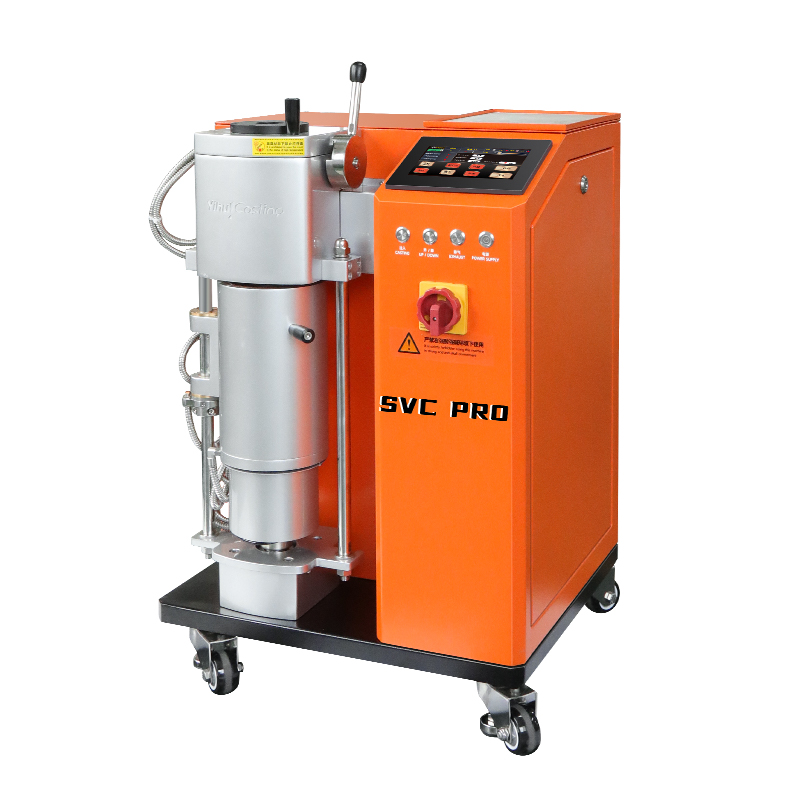
The vacuum system is the most failure-prone subsystem on vacuum pressure casting machines. Vacuum pump oil degradation, seal wear, and hose deterioration all reduce vacuum performance gradually—often going unnoticed until casting quality drops noticeably. Scheduled vacuum pump oil changes (weekly for high-volume operations), quarterly O-ring replacements on chamber seals, and annual hose replacement prevent the most common vacuum-related casting failures. The cost of vacuum pump oil and O-ring sets is negligible compared to the cost of a single failed casting run caused by inadequate vacuum.
2. Crucible and Heating System Maintenance on Melting Furnaces
Crucibles wear out through thermal cycling, chemical erosion from alloy fluxes, and mechanical damage from stirring and pouring. A crucible that fails during a melt can spill molten metal into the furnace chamber—a safety emergency and an expensive cleanup. Scheduled crucible replacement at 80 percent of rated service life, combined with weekly thermocouple accuracy checks and quarterly heating element inspections, prevents the majority of furnace-related downtime events.
3. Wax Injection System Servicing
Wax injectors require consistent attention to nozzle cleanliness, valve seal condition, and temperature calibration. A wax injector that produces defective patterns sends those defects downstream through investing, burnout, and casting—multiplying the cost of the original problem. Weekly nozzle cleaning, monthly valve seal inspection, and quarterly thermocouple verification keep wax pattern quality stable and prevent cascading defect costs.
4. Optical Maintenance on Laser Machines
Laser machine downtime most often originates from optical contamination or misalignment. A dirty focusing lens absorbs beam energy, reducing weld strength and cut quality—and eventually cracking the lens itself, requiring an unplanned replacement. Weekly lens cleaning and quarterly beam calibration cost minimal time and materials, but prevent the quality drift and component failures that cause expensive laser machine shutdowns.
5. Mechanical Component Lubrication and Inspection
All Yihui Casting equipment includes mechanical components—hinges, clamps, linear guides, and rotating assemblies—that require periodic lubrication and inspection. Friction from dry or contaminated bearings causes progressive wear that eventually produces mechanical failure: a stuck flask clamp, a jammed chamber lid, or a failed rotary mechanism. Monthly lubrication with the manufacturer's specified lubricant, combined with visual inspection for wear indicators, prevents mechanical failures that typically require 1 to 3 days for repair parts sourcing and installation.
A preventive maintenance program must be practical, sustainable, and cost-effective. Overly ambitious programs that require excessive time or specialized skills often collapse within months. The following framework balances thoroughness with feasibility for jewelry workshop environments.
1. Categorize Maintenance by Interval
Organize maintenance tasks into four intervals aligned with workshop workflow:
Daily: Operator-level tasks that take 5 to 15 minutes at end of shift—visual inspections, basic cleaning, oil level checks
Weekly: Technician-level tasks that take 30 to 60 minutes—oil changes, seal inspections, nozzle cleaning, lens cleaning
Monthly: Specialist-level tasks that take 1 to 2 hours—calibration checks, wear-part inspections, thermocouple verification, deep cleaning
Quarterly/Annual: Professional service tasks that take 4 to 8 hours—full system overhaul, calibration, component replacement campaigns
2. Assign Task Ownership
Every maintenance task must have an assigned owner. Daily tasks belong to the equipment operator. Weekly tasks belong to a designated senior technician. Monthly and quarterly tasks belong to a maintenance coordinator or service manager. Without assigned ownership, tasks are skipped—especially daily and weekly tasks that are easy to defer under production pressure.
3. Create Checklists and Logbooks
Develop written checklists for each maintenance interval and each machine type. Checklists serve two purposes: they ensure that no task is forgotten, and they provide a documentation trail that enables trend analysis. A logbook that records vacuum test results, thermocouple readings, and component replacement dates allows you to detect gradual performance degradation before it causes a failure.
4. Stock Spare Parts Strategically
Maintain an inventory of the most commonly needed replacement parts: O-ring sets, vacuum pump oil, thermocouples, crucibles, nozzle assemblies, lens cleaning supplies, and lubricants. The total cost of this spare parts inventory is typically under $500 for a small workshop and under $2,000 for a multi-machine operation. Having these parts on hand eliminates the 1 to 5 day wait that emergency parts sourcing imposes, reducing each downtime event from days to hours.
5. Calculate and Communicate ROI
Track the cost of preventive maintenance supplies and labor separately from the cost of emergency repairs and downtime. Most workshops find that their preventive maintenance investment pays for itself within the first 3 to 6 months through reduced emergency repair costs and fewer production stoppages. Sharing this data with workshop staff reinforces the value of the program and sustains compliance.
The cumulative effect of a well-executed preventive maintenance program is transformative for jewelry casting operations:
30 to 50 percent reduction in unplanned downtime: Equipment failures that previously caused 2 to 5 day shutdowns are caught during scheduled maintenance windows and resolved in hours
25 to 35 percent reduction in total maintenance costs: Scheduled component replacements and routine servicing cost significantly less than emergency repairs with secondary damage
Consistent casting quality: Equipment operating within specification produces castings with stable porosity levels, surface quality, and dimensional accuracy—eliminating the unpredictable quality swings caused by degraded equipment
Extended equipment lifespan: Well-maintained equipment routinely exceeds its rated service life by 20 to 40 percent, deferring the capital cost of replacement
Improved safety: Preventive maintenance identifies and resolves electrical faults, seal failures, and mechanical wear before they become safety hazards
Preventive maintenance on jewelry casting equipment is not an optional overhead—it is a core operational strategy that directly reduces downtime, repair costs, material waste, and quality variability. The maintenance actions described in this article address the most common failure modes across the jewelry casting equipment spectrum, from vacuum casting machines and melting furnaces to wax injectors and laser systems.
The framework for building a preventive maintenance program—interval-based task categorization, assigned ownership, checklists and documentation, strategic spare parts stocking, and ROI tracking—provides a practical starting point that any workshop can implement regardless of size or production volume.
The financial case is clear: every dollar invested in preventive maintenance returns 3 to 5 dollars in avoided emergency costs, reduced material waste, and preserved production capacity. For workshops that rely on precious metal casting equipment to deliver quality jewelry on schedule and on budget, preventive maintenance is the single most cost-effective operational investment available.
Yihui Casting designs jewelry casting equipment with maintenance accessibility in mind—clear service documentation, modular replacement components, and factory support that helps you build and sustain an effective maintenance program. Explore our complete range of casting solutions and protect your production investment with equipment built to last and maintain.
 online service
Scan to wechat :