When selecting a jewelry melting furnace, one of the primary technical decisions involves choosing between electric resistance heating and induction heating. Both technologies are widely used in jewelry workshops, but they differ significantly in heating mechanism, energy efficiency, temperature control precision, and operational characteristics. Understanding these differences helps workshop managers and production planners select the furnace type that aligns with their metal types, batch sizes, and quality requirements. This comparison examines both technologies across the factors that matter most in jewelry production.
Electric resistance furnaces heat metal indirectly. Electrical current passes through resistive heating elements — typically made of kanthal, silicon carbide, or molybdenum disilicide — which generate radiant heat. This heat transfers to the crucible and then to the metal inside through conduction and convection. The metal itself does not interact with the electromagnetic field; it is heated by the surrounding thermal environment.
Induction furnaces operate on a fundamentally different principle. An alternating current passes through a copper induction coil surrounding the crucible, generating an oscillating magnetic field. This field induces eddy currents within the conductive metal charge, causing the metal to heat itself from within. Because the heat is generated directly in the metal rather than transferred from an external source, induction heating is inherently more efficient for conductive materials like gold, silver, and copper.
This difference in mechanism has practical consequences. In a resistance furnace, the crucible and chamber must reach the target temperature before the metal fully melts, which introduces thermal lag. In an induction furnace, the metal begins heating immediately when the coil is energized, significantly reducing the time from cold start to pourable melt.
Induction furnaces generally achieve faster heating cycles than resistance furnaces of comparable capacity. A 1-kilogram induction furnace can typically melt gold from room temperature to pouring temperature in 3 to 5 minutes. A resistance furnace of the same capacity may require 10 to 15 minutes to reach the same state. For workshops running high melt frequencies, this difference compounds throughout a production day.
The speed advantage of induction heating stems from direct energy transfer. The electromagnetic field couples with the metal charge, converting electrical energy into thermal energy with minimal intermediary losses. Resistance furnaces lose energy heating the chamber walls, insulation, and crucible before that thermal energy reaches the metal. While modern resistance furnaces use refractory materials with good thermal efficiency, the fundamental physics of indirect heating impose a ceiling on speed.
However, heating speed is not the only determinant of production throughput. Furnaces must also cool between melts for crucible changes, alloy additions, or maintenance. Resistance furnaces, with their simpler construction and lower thermal mass in some designs, can be easier to manage during these transitions. The overall production cycle should be evaluated rather than melt time alone.
Both furnace types can achieve precise temperature control when equipped with modern instrumentation, but the characteristics of that control differ. Induction furnaces respond quickly to changes in power input, allowing the controller to adjust temperature within seconds. This rapid response is particularly valuable when working with alloys that have narrow melting ranges, where overshooting the target temperature can cause oxidation or volatile element loss.
Resistance furnaces exhibit greater thermal inertia. The heating elements, chamber lining, and crucible all retain heat, which means temperature changes take effect more slowly. While this can make overshoot less likely in some scenarios, it also means recovery from temperature drops — such as those caused by adding cold metal to the melt — takes longer. The result is a control characteristic that favors stability over responsiveness.
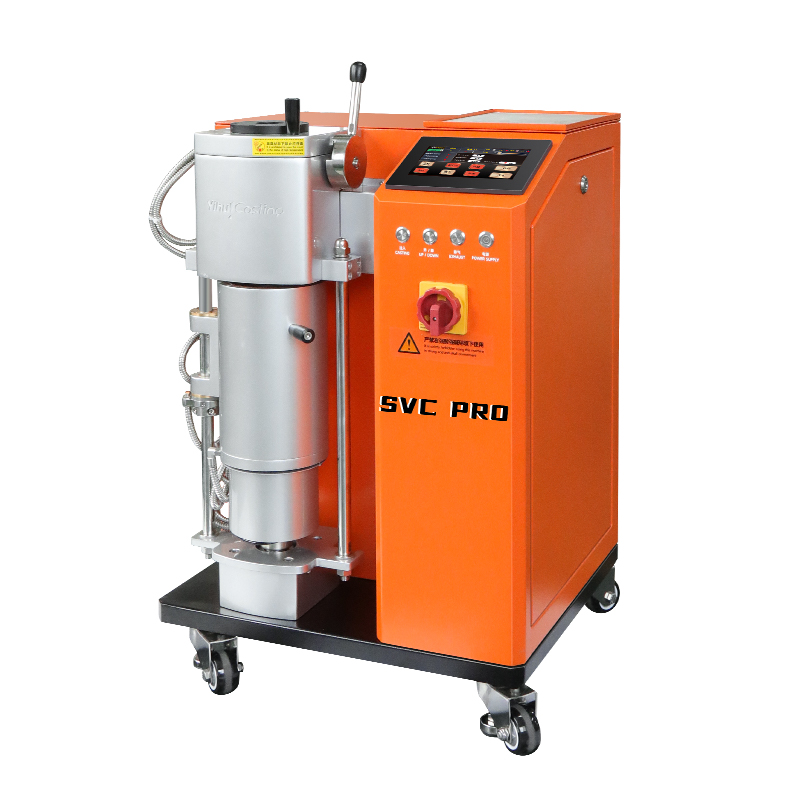
For gold and silver casting, both technologies provide adequate control when paired with quality thermocouples and PID controllers. For platinum work, which demands temperatures above 1,800°C, induction furnaces are generally preferred. Resistance furnaces capable of reaching platinum temperatures require specialized heating elements and insulation, which increases cost and complexity. Most vacuum pressure casting machine systems designed for platinum use induction heating for this reason.
Induction furnaces typically convert 70% to 85% of input electrical energy into heat within the metal, depending on coil design, frequency, and charge geometry. Resistance furnaces generally achieve 40% to 60% thermal efficiency for the metal charge, with the remainder lost to the chamber, insulation, and ambient environment. Over hundreds of melt cycles, this efficiency gap translates into measurable differences in electricity consumption.
However, the total operating cost calculation involves more than energy efficiency. Induction furnaces require more complex electrical systems, including frequency converters and cooling systems for the induction coil. These components add to capital cost and require periodic maintenance. Resistance furnaces use simpler electrical infrastructure, which reduces both initial investment and maintenance requirements.
The optimal choice depends on utilization patterns. Workshops running continuous melts throughout the day benefit from the lower per-melt energy cost of induction heating, which offsets the higher capital investment over time. Workshops with intermittent melting schedules — where the furnace sits idle for extended periods — may find resistance furnaces more economical, as the simpler design reduces standby losses and maintenance burden.
Induction heating provides a secondary benefit relevant to metal quality: electromagnetic stirring. The alternating magnetic field that heats the metal also induces movement within the melt, continuously mixing the molten metal. This stirring promotes alloy homogenization, ensuring that added elements distribute evenly throughout the charge. For workshops producing consistent alloy compositions, this feature reduces the risk of segregation and compositional variation between castings.
Resistance furnaces do not produce electromagnetic stirring. Metal homogeneity depends on manual stirring or convection currents, which may be insufficient for complex alloys. In practice, many operators stir resistance furnace melts manually, which introduces variability and increases the risk of contamination from stirring tools.
Contamination risk also differs between the two technologies. Induction furnaces typically use crucibles that do not contact heating elements directly, reducing the risk of element material migrating into the melt. Resistance furnaces, where heating elements are in proximity to the crucible, carry a higher risk of contamination if elements degrade or if crucible failure brings molten metal into contact with furnace components.
The choice between electric resistance and induction jewelry melting furnaces depends on the specific requirements of the workshop. Induction furnaces offer faster heating, higher energy efficiency, electromagnetic stirring for alloy homogenization, and superior performance at high temperatures required for platinum casting. Resistance furnaces provide simpler construction, lower capital cost, and adequate performance for gold and silver work in lower-volume settings.
Workshops processing platinum or running high-frequency melt cycles generally benefit from induction technology despite its higher initial cost. Workshops focused on gold and silver casting with moderate production volumes may find resistance furnaces a practical and economical choice. In either case, the furnace should be evaluated as part of the complete jewelry casting equipment lineup, considering compatibility with casting machines, crucible types, and production workflow.
Yihui Casting offers both induction and resistance melting furnaces designed for jewelry production, with specifications tailored to different metal types and batch sizes. Explore our melting furnace catalog to compare models and identify the technology that best fits your workshop's efficiency and temperature control requirements.
 online service
Scan to wechat :