The production of wax patterns is the critical first step in lost wax casting, and the method chosen to create those patterns directly influences the detail quality, surface finish, and dimensional precision of the final metal piece. 3D jewelry printer technology and traditional vacuum wax injector systems represent two fundamentally different approaches to pattern production, each with distinct advantages in specific applications. This article provides a technical comparison focused on detail accuracy, surface quality, and practical production considerations.
Traditional wax injection uses a metal mold, typically machined from brass or aluminum, into which molten wax is injected under pressure and vacuum. The mold is created from a master pattern, which itself must be fabricated by hand carving, CNC machining, or other subtractive methods. The quality of the wax pattern is directly determined by the quality of the mold, and the mold represents a significant upfront investment in both time and cost. Once the mold exists, wax patterns can be produced quickly, with cycle times of 30 to 90 seconds per pattern for simple geometries.
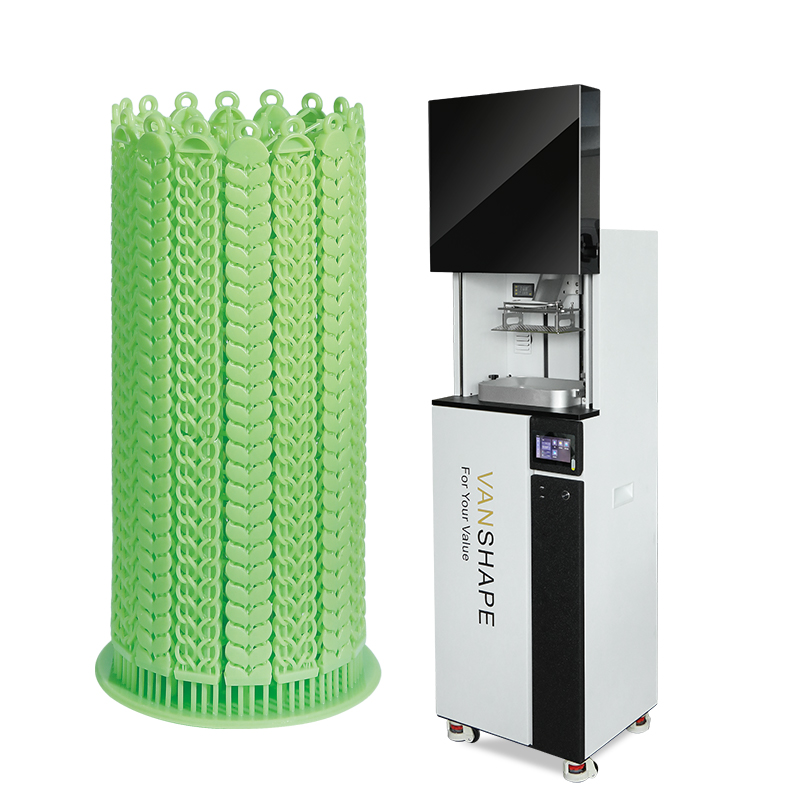
A 3D jewelry printer builds wax or castable resin patterns layer by layer from a digital CAD model, eliminating the need for a physical mold. Digital Light Processing (DLP) and stereolithography (SLA) are the predominant technologies for jewelry wax printing, with wax-based or wax-filled photopolymer resins developed specifically for investment casting burnout. The printer exposes each layer to UV light according to the pattern defined by the CAD model, building the pattern from the build platform upward.
The fundamental difference is that wax injection is a replication process limited by mold quality, while 3D printing is an additive manufacturing process limited by layer resolution and material properties. Understanding this distinction is essential for selecting the appropriate method for a given application.
The practical detail resolution of a 3D jewelry printer is determined primarily by its optical system and layer thickness. Current professional-grade DLP printers for jewelry achieve XY resolution of approximately 35 to 50 microns, with Z-axis layer thicknesses of 10 to 50 microns. At 35 micron XY resolution, features smaller than approximately 70 microns are not reliably reproduced because two pixels are needed to define an isolated feature. This means details such as the serifs on letters under 1 millimeter in height or the texture of pavé-set diamond surfaces may not be fully resolved.
Traditional vacuum wax injector systems can replicate details as fine as the mold allows, and high-quality CNC-machined brass molds can resolve features at the 10 to 20 micron level when filled with low-viscosity injection waxes. The smooth, non-layered surface of injection wax patterns provides a surface finish that directly translates to the metal casting without the stair-step artifacts characteristic of layer-based printing.
However, this comparison requires a caveat. The mold-making process itself has resolution limits. If the master pattern is hand-carved, detail resolution is limited by the carver's skill and tools, which rarely achieve better than 50 micron precision on complex organic forms. If the master is CNC-machined, the cutter radius and step-over distance impose geometric constraints similar to those of 3D printing. The advantage of mold-based injection is surface smoothness and repeatability, not necessarily superior ultimate resolution compared to a well-calibrated 3D printer.
Surface finish is the area where traditional wax injection maintains its clearest advantage. Injection wax patterns have a glossy, defect-free surface that requires little to no post-processing before investing. The cast metal surface replicates this smoothness, reducing the labor required for jewelry polishing machine work after casting. For high-volume production of standard articles such as wedding bands and solitaire ring settings, this surface quality advantage translates directly to lower finishing labor cost per piece.
3D printed patterns exhibit layer lines that must be addressed before or after casting. Post-print smoothing can be performed using solvent vapor exposure, gentle heating, or manual brushing with a solvent such as isopropyl alcohol. Each of these methods partially smooths the surface but also removes a small amount of material, potentially affecting the dimensions of fine details. Even after smoothing, printed patterns generally produce a casting surface that requires more bench work than a mold-injected wax pattern.
The surface quality gap has narrowed substantially with recent resin formulations. Specialized castable wax resins with low viscosity during printing achieve smoother layer transitions, and some systems now offer anti-aliasing algorithms that vary the curing energy at feature edges to reduce the stair-step effect. For articles with organic textures, filigree work, or surfaces where a slight texture is acceptable, the surface quality of modern castable resins is commercially viable without extensive post-processing.
Where 3D printing decisively outperforms traditional wax injection is in geometric freedom. A 3D printer can produce undercuts, internal channels, lattice structures, interlocking parts, and complex organic forms that are either impossible or prohibitively expensive to mold. This capability has enabled entirely new categories of jewelry design, particularly in the custom and artistic segments.
Traditional mold making becomes exponentially more complex and expensive as geometry becomes more intricate. A multi-part mold with slides, cores, and multiple parting lines may be required for a single design, and the mold cost can exceed the printer cost for highly complex patterns. For one-off custom pieces and short production runs of complex designs, 3D printing is not merely competitive but transformative, reducing the pattern production cost by an order of magnitude compared to custom mold fabrication.
The practical implication for a jewelry workshop is that the choice between methods depends on the design characteristics of the product line. Standard solitaire settings, plain bands, and simple pendants can be produced more cost-effectively and with better surface finish using wax injection from a quality mold. Custom designs with undercuts, hollow forms, mesh patterns, or personalized elements such as fingerprints and handwriting are better suited to 3D printing.
The economics of pattern production methods are volume-dependent, with a clear crossover point where each method becomes more cost-effective. Traditional wax injection has high upfront tooling cost but very low per-pattern cost once the mold exists. A CNC-machined brass mold for a ring setting may cost USD 300 to USD 1,500 depending on complexity. Amortized over 1,000 wax patterns, the per-pattern tooling cost contribution is USD 0.30 to USD 1.50, plus wax material and operator time.
3D printing eliminates tooling cost but has higher direct per-pattern cost. Castable wax resin costs approximately USD 150 to USD 300 per liter, yielding roughly 200 to 500 ring-sized patterns per liter depending on pattern geometry and support structure efficiency. The per-pattern resin cost is therefore USD 0.30 to USD 1.50, comparable to the amortized tooling cost of injection wax patterns at moderate volumes but without the upfront investment.
The crossover volume where injection becomes cheaper than printing typically falls between 50 and 200 identical patterns, depending on mold cost and article complexity. Below this volume, printing is more economical. Above it, the mold investment pays for itself through lower ongoing per-pattern costs. For workshops producing large quantities of standardized articles, maintaining a library of injection molds remains the most cost-effective approach.
The workflow implications extend beyond pattern production to encompass the entire process from design to cast piece. A 3D printing workflow begins with CAD design, which can be iterated rapidly without modifying physical tooling. Design changes are made in the digital model and printed immediately, enabling same-day design iteration that is impossible with mold-dependent methods where each design change requires mold modification or re-fabrication.
The wax injection workflow is significantly faster per pattern once the mold exists. A skilled operator can produce 30 to 60 wax patterns per hour from a single mold cavity. A 3D printer producing a full build plate of 20 to 40 patterns requires 2 to 6 hours for the print cycle, averaging 5 to 20 patterns per hour depending on layer thickness and build plate utilization. For high-volume production of a single design, injection maintains a clear throughput advantage.
Many workshops now operate a hybrid approach, using 3D jewelry printers for custom orders, short runs, and new design development, while maintaining wax injection for high-volume standard articles. This combination captures the geometric freedom and iteration speed of additive manufacturing while preserving the throughput and surface quality advantages of traditional injection molding for production work.
Neither 3D printing nor traditional wax injection is universally superior for jewelry pattern production. Injection molding from quality metal molds produces wax patterns with smoother surfaces and at higher throughput for standardized designs, making it the preferred method for volume production of simple-to-moderate complexity articles. 3D printing offers geometric freedom, zero tooling cost, design iteration speed, and superior economics for low volumes and complex geometries, making it essential for custom work and short-run production.
The optimal approach for most professional workshops is to deploy both methods according to their strengths. Yihui Casting supplies both 3D jewelry printers and industrial-grade wax injection systems, enabling jewelry manufacturers to build a flexible pattern production capability that serves the full range of their product requirements. Contact our application team to discuss which combination of equipment best matches your design portfolio and production volume targets.
 online service
Scan to wechat :