The gulf between entry-level and professional jewelry casting equipment extends far beyond the purchase price. Choosing between these categories involves trade-offs that affect daily production quality, operator skill requirements, maintenance costs, and the trajectory of a jewelry business over its three-to-five-year planning horizon. This article provides a structured comparison to help workshop owners and production managers make an informed decision.
Entry-level precious metal casting equipment typically refers to machines designed for production volumes of fewer than 50 pieces per day, with manual or semi-automatic controls, limited programmability, and a focus on gold and silver alloys. These machines generally offer metal capacities of 1 kg or less, accommodate a single flask size, and rely on the operator's skill for consistent results. Purchase prices for entry-level vacuum casting machines range from approximately USD 3,000 to USD 8,000 depending on features and capacity.
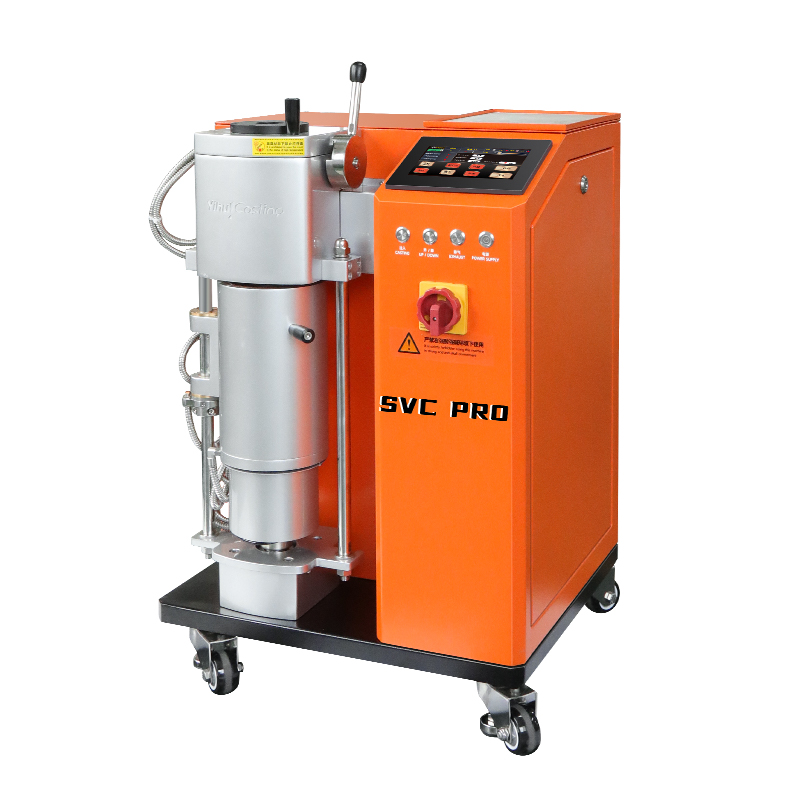
Professional-grade equipment serves production volumes of 100 to 500 or more pieces per day, with full PLC-based automation, multi-recipe storage, data logging capabilities, and support for a broader range of alloys including platinum and palladium. Metal capacities of 2 to 6 kg are common, with multiple flask size compatibility and advanced features such as electromagnetic stirring, automated alloy temperature detection, and integrated cooling cycles. Professional machines typically cost USD 12,000 to USD 40,000, with high-capacity automated systems exceeding this range.
The critical distinction is not merely the price band but the underlying design philosophy. Entry-level machines are built to a cost target with acceptable performance under narrow operating conditions. Professional machines are engineered for reliability across a wide operating envelope, designed for multi-shift operation, and built with components rated for tens of thousands of cycles rather than thousands.
The most significant operational difference between entry-level and professional vacuum pressure casting machine systems is the level of automation and its impact on skill dependency. Entry-level equipment places the burden of consistency on the operator. The operator must judge molten metal readiness by eye, manually sequence vacuum and pressure valves, and adjust parameters based on experience and intuition. This introduces variability between operators and between shifts that manifests as inconsistent casting quality.
Professional equipment automates the entire casting sequence from preheat through cooling. The operator loads the flask and crucible, selects a stored recipe, and presses start. The machine controls heating ramp rate, hold temperature and duration, vacuum pull sequence, pressure application profile, and even the cooling ramp. This automation reduces the skill floor required for consistent operation and provides documented process parameters for every casting cycle, supporting quality management systems such as ISO 9001.
The financial impact of this difference becomes apparent when calculating the cost of casting defects. If an entry-level machine produces a 3 percent defect rate and a professional machine achieves 1 percent, the difference on 100 castings per day at an average metal value of USD 50 per piece is USD 100 per day in metal alone, before accounting for rework labor and production delay costs. Over a year of operation, this single factor can justify a significant portion of the price difference between machine categories.
Entry-level machines are typically optimized for standard karat gold alloys and sterling silver. These alloys have well-characterized melting behavior and forgiving casting characteristics. When a workshop expands to include platinum, palladium, or specialized white gold alloys, the limitations of entry-level equipment become apparent.
Casting platinum requires sustained temperatures exceeding 1,800 degrees Celsius, which demands induction coil designs, crucible materials, and thermal insulation rated for these conditions. Professional-grade jewelry melting furnace systems and integrated casting machines incorporate high-temperature crucibles, specialized flask handling for the higher thermal mass, and cooling sequences that accommodate platinum's slower solidification behavior. Entry-level equipment rarely provides the temperature headroom or control precision needed for consistent platinum casting.
Alloy compatibility also extends to reactive metals and specialized formulations. Some palladium white gold alloys and colored gold formulations are sensitive to atmospheric contamination during melting. Professional machines typically include inert gas purging capability, allowing the melt chamber to be flushed with argon or nitrogen before heating begins. This feature is uncommon in entry-level equipment and represents a hard limitation on the types of work a shop can produce.
The purchase price of precious metal casting equipment is only the first entry in a multi-year cost ledger. Component longevity, maintenance frequency, spare parts availability, and downtime cost all contribute to total cost of ownership (TCO) and differ substantially between equipment categories.
Vacuum pumps in professional equipment are typically industrial-grade rotary vane pumps rated for 10,000 to 20,000 operating hours before major service. Entry-level machines may use smaller pumps rated for 2,000 to 5,000 hours. In a facility operating two shifts per day, a professional-grade pump might require rebuild service every three to four years, while an entry-level pump requires service annually. Each pump rebuild represents both parts cost and production downtime.
Induction power supplies in professional machines use solid-state IGBT technology with advanced protection circuits that prevent damage from power fluctuations, coolant flow interruptions, and coil faults. Entry-level machines may use simpler SCR-based power supplies with fewer protection features, making them more susceptible to damage from electrical supply issues common in industrial environments.
A realistic five-year TCO comparison should include: purchase price, installation and facility modifications, consumables (crucibles, seals, pump oil), scheduled maintenance parts and labor, unscheduled repair costs based on mean time between failures, production downtime value, and energy consumption. In many scenarios, the five-year TCO of a professional machine approaches or falls below that of an entry-level unit due to lower operating and failure costs, even though the initial capital outlay is higher.
Entry-level equipment is the appropriate choice in several specific scenarios. Start-up workshops with constrained capital budgets and daily production below 30 pieces can achieve adequate quality with careful operator training and a limited alloy range. Educational institutions and training centers benefit from the lower capital cost and the teaching value of manual operation, as students learn process fundamentals that are abstracted away by automation. Research and development labs with intermittent use patterns may never accumulate the operating hours that justify a professional machine's durability.
Professional equipment becomes the clear choice when production exceeds approximately 50 pieces per day, when the product mix includes high-value alloys such as platinum, when consistent quality across multiple shifts is critical, or when the workshop operates under a formal quality management system requiring process documentation. The ability to scale production by adding shifts without adding variability is a strategic advantage that professional equipment provides.
The transition point for many growing workshops occurs when the cost of casting defects and rework begins to approach the monthly financing cost of a professional machine. At this inflection point, continuing with entry-level equipment directly constrains profitability and growth potential.
The choice between entry-level and professional precious metal casting equipment is ultimately a business decision rather than a purely technical one. The analysis must account for current production volume, near-term growth trajectory, alloy diversity, quality requirements, and the full cost of production defects and downtime in your specific operation.
Yihui Casting provides equipment across both categories and offers consultation to help workshops determine which level of machine aligns with their business requirements. Our application engineers can provide detailed TCO comparisons using your actual production parameters. Request a consultation to receive a customized equipment recommendation.
 online service
Scan to wechat :