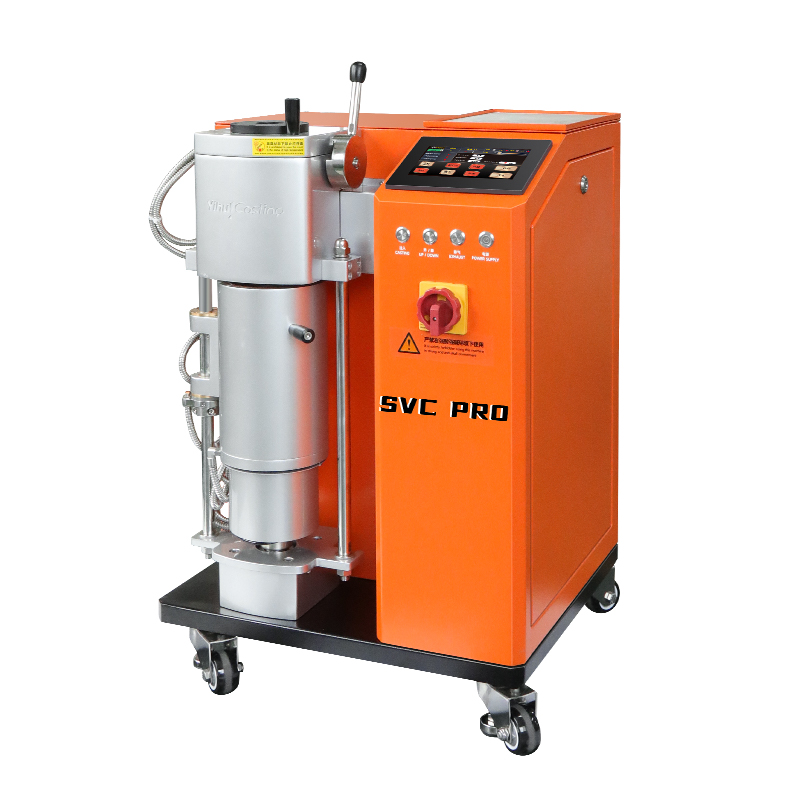
Capacity specifications on vacuum pressure casting machine data sheets are often reduced to a single number: maximum kilograms of gold per cycle. While this figure serves as a rough sizing guide, the relationship between machine capacity and actual production outcomes runs far deeper. Capacity choices affect metal flow dynamics, solidification behavior, flask utilization, and ultimately the quality and consistency of every casting produced.
This article examines how casting machine capacity interacts with output quality and production efficiency, providing a framework for matching machine size to workshop requirements without sacrificing casting integrity.
The stated capacity of a vacuum pressure casting machine typically refers to the maximum weight of pure gold the system can melt in a single crucible charge. However, this specification has practical limits that warrant careful examination. First, the rated capacity assumes a specific crucible geometry and alloy density. When casting silver, which has roughly half the density of gold, the effective capacity by volume remains the same while the weight capacity is proportionally lower.
Second, the melting time specified at maximum capacity often represents ideal conditions with a clean crucible and optimal power supply. In daily production, where crucibles accumulate residue and line voltage may fluctuate, realistic melting times can be 15 to 30 percent longer. Running a machine continuously at its maximum rated capacity also accelerates wear on the induction coil, power supply components, and crucible lining.
A more useful metric is the machine's efficient operating range, which for gold casting typically falls between 60 and 80 percent of the maximum rated capacity. Within this range, melting is rapid and temperature control remains stable. Pushing beyond 80 percent extends cycle times and increases the risk of incomplete melting or temperature overshoot that degrades alloy properties.
Flask size compatibility defines the physical limits of what patterns can be cast in a single cycle, making it the most direct link between machine capacity and production throughput. A vacuum pressure casting machine that accepts 4-inch diameter flasks with a 9-inch height can accommodate approximately 5 to 8 tree-mounted patterns per cycle for typical ring production. Moving to a 5-inch by 12-inch flask configuration increases pattern capacity by 60 to 80 percent in a single pour.
The efficient operating range concept applies to flask utilization as well. Underfilling a large flask wastes investment material, extends burnout time, and reduces per-cycle metal utilization if the metal charge is proportionally smaller. Investment material cost per cast piece increases when flask space is not fully utilized. Conversely, overfilling a flask beyond the manufacturer's recommended sprue-to-wall clearance of 10 to 15 millimeters increases the risk of investment cracking during the pour, leading to metal penetration and casting defects.
Production efficiency calculations should account for the full cycle time, not just the melting phase. A larger flask requires longer burnout cycles in the kiln and longer cooling time after casting. If your kiln capacity and workflow cannot support the larger flask cycle time, the throughput advantage of a bigger machine is partially offset by upstream and downstream bottlenecks.
The relationship between machine capacity and casting quality centers on metal flow dynamics during the pour. A vacuum pressure casting machine uses vacuum to draw metal into the mold cavity and pressure to pack the metal into fine details. The available vacuum and pressure force must be sufficient to overcome the flow resistance of the sprue network and the surface tension effects at the metal-frontier interface within thin sections.
When a machine is operated near its maximum metal charge, the thermal mass of the larger melt can actually benefit flow characteristics because the metal stays fluid longer during the pour. However, this advantage only holds if the machine's vacuum and pressure systems are sized proportionally to the metal volume. A machine designed for 2 kg capacity but operating with a 3 kg charge may exhibit insufficient pressure to fill thin-walled sections consistently, resulting in incomplete casts or shrinkage porosity.
The solidification time also varies with charge size. A larger molten mass retains heat longer, which promotes directional solidification from the flask wall inward if the investment temperature and flask geometry are properly matched. This directional cooling pattern produces denser castings with fewer internal voids. However, excessively large charges relative to flask size can reverse this beneficial effect, causing the last sections to solidify under reduced feeding pressure as the sprue button freezes prematurely.
Selecting the right machine capacity requires a clear understanding of current and projected daily production volumes, metal types, and article diversity. For a small custom workshop producing 20 to 30 gold rings per day, a 1 kg capacity machine using 3.5-inch flasks typically provides adequate throughput with manageable metal inventory requirements. The smaller capacity also reduces the working capital tied up in metal in process.
Mid-sized production facilities targeting 100 to 200 pieces per day benefit from 2 to 3 kg capacity machines with 4-inch or 5-inch flask capability. At this scale, multiple flasks can be prepared in staggered burnout cycles to keep the vacuum pressure casting machine running near-continuously during production hours. The per-piece energy cost decreases as machine utilization increases, contributing to a lower unit production cost.
Large factories producing 500 or more pieces daily often operate multiple machines in parallel rather than a single high-capacity unit. This redundancy provides production continuity during maintenance and allows different alloys to be cast simultaneously without cross-contamination. Each machine in a multi-unit setup can be optimized for a specific alloy family, such as dedicating one unit to platinum group metals while another handles 14K and 18K gold alloys.
Machine capacity directly influences energy consumption per cast piece, an often overlooked factor in total cost of ownership calculations. A vacuum pressure casting machine primarily consumes energy during the melting phase, with auxiliary consumption from the vacuum pump and control systems. The energy required to melt a given weight of metal is approximately fixed by the specific heat and latent heat of fusion of the alloy, but energy losses to the environment increase with melting time.
Operating a machine at 50 percent of rated capacity for every cycle nearly doubles the per-piece energy cost compared to running at 80 percent capacity because the base energy overhead (pump operation, control system, crucible heating) is spread across fewer pieces. The sweet spot for cost efficiency is typically 70 to 85 percent of rated capacity, where melting times remain short and the fixed energy overhead is well distributed.
For facilities with time-of-use electricity pricing, the ability of higher-capacity machines to complete more cycles within off-peak rate windows can yield significant operating cost savings. A 3 kg machine completing three cycles per hour during an 8-hour off-peak window processes substantially more metal than a 1 kg machine operating at the same cycling rate, multiplying the per-kWh cost advantage.
Several measurable quality indicators correlate with machine capacity utilization. Porosity rates, measured as the percentage of castings requiring rework for gas or shrinkage porosity, tend to increase when machines are consistently operated above 90 percent of rated capacity. This occurs because the vacuum and pressure systems have less headroom to compensate for variations in flask permeability or sprue design.
Dimensional consistency across multiple cycles also degrades at the upper end of capacity utilization as thermal conditions become less repeatable. The coefficient of variation in critical dimensions such as ring shank thickness or bezel wall thickness can be significantly higher when the melting system is pushed to its thermal limits. Maintaining capacity utilization below 85 percent of rated maximum provides a quality buffer that protects against these stochastic variations.
Surface finish quality, particularly in platinum and white gold alloys, benefits from the higher metal head pressure available when casting charges that fully utilize the machine's rated pressure capacity. Larger charges provide greater metallostatic pressure at the bottom of the flask, helping to produce sharper detail reproduction and lower surface roughness at the casting surface. This effect is most pronounced in tall flasks where the pressure gradient from top to bottom is significant.
Machine capacity is not simply a question of "how much metal can you melt." It is a system-level specification that influences casting quality, production throughput, energy cost, and operational flexibility. The optimal capacity choice balances today's production needs against a realistic assessment of volume growth, allowing the vacuum pressure casting machine to operate in its efficient range during normal production while maintaining reserve capacity for peak demand periods.
When evaluating equipment from Yihui Casting, discuss your specific production profile with our application engineers. We can help you determine the flask sizes, metal capacities, and machine configurations that will deliver consistent quality and efficient operation for your particular product mix and volume requirements.
 online service
Scan to wechat :