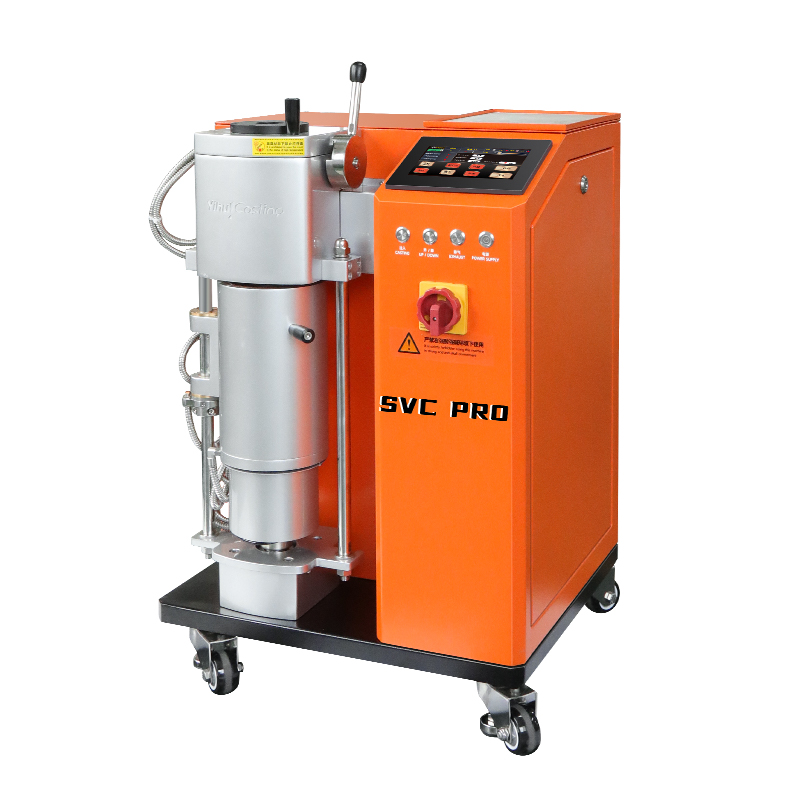
Vacuum pressure casting machine technology evacuates the mold chamber to 0.01-0.05 MPa residual pressure before injecting molten metal under controlled positive pressure of 0.1-0.2 MPa. The vacuum phase removes oxygen and trapped gases from the investment mold cavity, while the subsequent pressure injection forces metal into every detail of the pattern — including filigree channels thinner than 0.3mm and micro-settings requiring ±0.05mm dimensional accuracy.
The process cycle typically takes 3-5 minutes per flask: vacuum evacuation (30-60 seconds), melting phase (variable by metal type and capacity), pressurized injection (5-15 seconds), and controlled solidification under maintained pressure. Machines like the Yihui AVC-EV series support melting capacities of 2.5kg per cycle, suitable for gold, silver, copper, and K-gold alloys with argon or nitrogen gas protection to minimize oxidation. Induction heating reaches 1400°C with ±1°C stability via Omron temperature controllers, ensuring consistent melt viscosity across repeated cycles.
First-pass yield data from workshops using vacuum pressure casting consistently shows 92-98% for gold and silver pieces, compared to 70-85% for gravity methods. Porosity levels stay below 0.5% per ASTM B928 testing, and surface roughness (Ra) measures 0.8-1.2μm — ready for final finishing without intermediate grinding steps.
Centrifugal casting machine technology relies on rotational force to inject molten metal into the investment mold. The machine spins the flask at speeds up to 1000 RPM (adjustable via servo motor control), generating centrifugal force that pushes metal outward through the mold cavity. This mechanical injection method excels at filling thin sections and intricate details where gravity alone would fail.
Yihui's CC350 centrifugal caster features unique dual swing arms that amplify centrifugal force distribution — ensuring more uniform metal density throughout the casting compared to single-arm designs. The servo motor delivers rapid acceleration (reaching target RPM within 2-3 seconds), which is critical for platinum casting where the narrow solidification window demands instantaneous mold filling. The machine operates on single-phase 220V/50Hz power with 30A current draw, fitting standard workshop electrical infrastructure without modification.
Centrifugal casting achieves particularly strong results with high-density metals: platinum (PT) castings consistently reach 88-94% first-pass yield, and K-gold pieces in smaller batch sizes (1-3 flasks per cycle) show excellent detail reproduction. The process is inherently faster per cycle — typically 60-90 seconds from spin initiation to solidification — enabling higher throughput for workshops focused on repetitive small-batch production.
The fundamental quality difference between the two methods stems from their injection mechanisms. Vacuum pressure casting eliminates air entrapment before injection begins, while centrifugal casting pushes air out through rotational momentum — but residual gas pockets can persist in complex internal geometries.
Quantitative comparison based on ASTM E155 testing standards:
| Metric | Vacuum Pressure | Centrifugal |
|---|---|---|
| Porosity (% volume) | 0.3-0.5% | 0.8-1.5% |
| Surface Ra (μm) | 0.8-1.2 | 1.5-3.0 |
| Dimensional accuracy | ±0.05mm | ±0.08mm |
| Filigree fill rate | 98-100% | 92-96% |
| Internal defect rate | <2% | 3-5% |
For workshops producing high-end jewelry with mirror finish requirements, vacuum pressure casting provides a superior starting surface — reducing post-cast finishing time by 40-50%. When paired with an electrolytic polishing machine, the combined process achieves final Ra values below 0.1μm (mirror grade per ISO 4288) in a single finishing pass, compared to 2-3 mechanical polishing stages required for centrifugal-cast pieces.
Not all metals respond equally to both casting methods. The choice between vacuum and centrifugal must account for your primary metal types:
Vacuum Pressure Casting — Best suited for:
Gold (Au) and gold alloys (K-gold 14K-22K): 92-98% yield
Silver (Ag): 90-95% yield with argon protection
Copper (Cu) and bronze: 88-93% yield
Low-melting-point alloys (<1100°C): optimal gas protection benefits
Centrifugal Casting — Best suited for:
Platinum (PT, melting point 1768°C): 88-94% yield — the rapid injection fills the mold before platinum's extremely narrow solidification window closes
Palladium alloys: 85-92% yield
Small-batch K-gold and silver where speed matters more than maximum yield
High-density metals where centrifugal force naturally compacts the crystalline structure
Workshops casting primarily gold and silver jewelry (representing 75-80% of global jewelry production per the World Gold Council 2025 data) will generally achieve better overall results with vacuum pressure technology. Workshops specializing in platinum jewelry — a smaller but higher-value segment — benefit from centrifugal casting's rapid fill capability.
Vacuum pressure casting machines process one flask per cycle (3-5 minutes), but automated models like the Yihui DVC-II and DVC-III handle sequential flask processing with programmable parameters — enabling 12-20 flasks per hour in continuous operation. The automatic models store up to 100 casting programs, allowing instant parameter switching between different metal types and piece sizes.
Centrifugal casting offers higher per-cycle speed (60-90 seconds) but processes one flask per spin. The CC350's servo motor enables rapid cycle turnover, potentially reaching 25-35 flasks per hour in experienced hands. However, the manual flask loading and unloading time becomes the bottleneck — each flask requires 30-45 seconds of handling between cycles.
For workshops producing fewer than 50 pieces per day, either method provides adequate throughput. For medium-volume operations (50-200 pieces/day), vacuum pressure casting with automation offers better consistency and lower labor dependency. High-volume workshops (200+ pieces/day) may benefit from running both technologies in parallel — vacuum for gold/silver quality pieces, centrifugal for rapid platinum and small-batch orders.
Cost comparison over a 3-year ownership period (based on 8-hour daily operation, 250 working days/year):
Vacuum Pressure Casting (AVC-EV class):
Equipment investment: $8,000-15,000
Argon/nitrogen gas: $1,200-2,000/year
Power consumption: 3.5-5.5 kW per cycle → $800-1,200/year
Maintenance: $300-600/year (induction coil replacement every 18-24 months)
Metal loss: 0.3-0.8% per casting cycle
3-year total: $12,000-22,000
Centrifugal Casting (CC350 class):
Equipment investment: $5,000-10,000
No gas protection required: $0/year
Power consumption: 2.0-3.0 kW per cycle → $500-800/year
Maintenance: $200-400/year (servo motor and swing arm bearings)
Metal loss: 0.8-1.5% per casting cycle (higher due to spin-induced turbulence)
3-year total: $7,500-13,200
The centrifugal method offers lower entry cost and simpler operation — no gas supply infrastructure required. However, the higher metal loss rate (0.8-1.5% vs 0.3-0.8%) compounds significantly when working with precious metals. For a workshop processing $500,000/year in gold and silver, the difference in metal loss alone amounts to $2,500-7,000 annually — potentially offsetting the centrifugal machine's lower purchase price within 2-3 years.
Use this decision matrix to determine the right casting technology for your specific operation:
Choose Vacuum Pressure Casting if:
Your primary metals are gold, silver, and copper alloys (>70% of production)
You need surface quality that minimizes post-cast finishing (Ra <1.5μm target)
Your pieces include extensive filigree, micro-settings, or thin-wall sections (<0.5mm)
You want automated, programmable production for consistent batch-to-batch results
You process higher volumes (50+ flasks/day) and need lower labor dependency
Metal loss reduction directly impacts your material cost structure
Choose Centrifugal Casting if:
You cast platinum or palladium alloys regularly (>20% of production)
Your workshop handles small batches (1-10 flasks per session) with frequent metal changes
Budget constraints favor lower initial investment and simpler infrastructure
Your designs favor bold, geometric shapes rather than intricate micro-detail
Rapid turnaround is more valuable than maximum first-pass yield
You operate in a space-constrained environment (centrifugal machines are generally more compact)
Consider Both if:
Your product mix spans both gold/silver fine jewelry and platinum pieces
You want maximum production flexibility to serve diverse client requirements
Your workshop volume exceeds 150 flasks/day, enabling parallel operation efficiency
Yihui Casting Technology Co., Ltd. — established in 2003 in Guangzhou Panyu — manufactures both vacuum pressure and centrifugal casting machines from its 32,000 sqm production facility across 5 factories. With 300+ staff including 20+ R&D engineers and 40+ patent certificates, the company brings 21+ years of direct manufacturing experience to each machine design.
ISO 9001:2015 certification governs all production processes, with CE certification validating international safety compliance. SGS testing and AAA credit rating further confirm quality standards. Over 5,000 jewelry manufacturers across 60+ countries operate Yihui equipment daily — providing a statistically significant dataset of real-world performance across diverse workshop conditions, metal types, and production volumes.
Whether you select vacuum pressure or centrifugal technology, choosing equipment from an established manufacturer with demonstrated production volume and certified quality systems reduces your risk and accelerates your workshop's learning curve. The right casting machine, matched to your specific metal mix and production goals, becomes the foundation of a profitable jewelry manufacturing operation.
 online service
Scan to wechat :