The quality of a jewelry rubber mold depends significantly on the precision of vulcanizer temperature and pressure settings during the curing process. Even slight deviations from optimal parameters can produce molds with incomplete vulcanization, surface defects, dimensional instability, or reduced lifespan. For jewelry workshops using mold making equipment for jewelry, understanding the relationship between vulcanization parameters and mold quality is essential for producing high-detail molds that consistently yield accurate wax patterns.
This article provides technical guidance on vulcanizer temperature and pressure settings for different rubber materials, mold complexities, and frame sizes. The recommendations are based on established jewelry manufacturing practices and are intended for workshop technicians and production managers responsible for mold quality control.
Vulcanization is a chemical process in which raw rubber compound is transformed into a durable, elastic material through the application of heat and pressure. During vulcanization, sulfur cross-links form between polymer chains, creating a three-dimensional network that gives the rubber its characteristic properties of elasticity, strength, and thermal stability.
In jewelry mold making, the vulcanization process occurs inside aluminum mold frames packed with uncured rubber sheets surrounding a master pattern. The frame is placed between the heated platens of a vulcanizer, where controlled temperature and pressure are applied for a specific duration. The three parameters — temperature, pressure, and time — must be coordinated to achieve complete and uniform curing throughout the mold.
Incomplete vulcanization results in molds with soft areas, tacky surfaces, and poor dimensional stability. Over-vulcanization causes excessive hardening, loss of elasticity, and brittleness that leads to cracking during mold cutting or wax injection. Both conditions compromise the mold's ability to reproduce fine details and reduce its operational lifespan.
The curing temperature for jewelry rubber molds varies depending on the rubber formulation. Most jewelry-grade natural rubber compounds used in mold making fall into two categories: standard curing and fast curing, each requiring different temperature profiles.
Standard Natural Rubber (150°C to 165°C): The most commonly used temperature range for natural rubber mold making is 150°C to 165°C. At 150°C, a standard mold frame (approximately 50mm thick) requires approximately 45 to 55 minutes of curing time. At 165°C, the same mold can be fully cured in 25 to 35 minutes. While higher temperatures reduce curing time, they also increase the risk of thermal gradients within the mold, particularly in thicker frames where the center may lag behind the surface in temperature. For high-detail molds, a moderate temperature of 155°C with a longer curing time of 40 to 50 minutes produces more uniform vulcanization and better detail reproduction.
Fast-Curing Rubber (165°C to 175°C): Fast-curing rubber compounds are formulated to reduce production time, requiring temperatures of 165°C to 175°C. At 170°C, a standard frame can be cured in 15 to 25 minutes. However, fast-curing compounds are less forgiving of temperature deviations, and the narrower processing window makes them less suitable for complex molds with intricate detail. Workshops should use fast-curing rubber primarily for simpler designs where speed is prioritized over maximum detail fidelity.
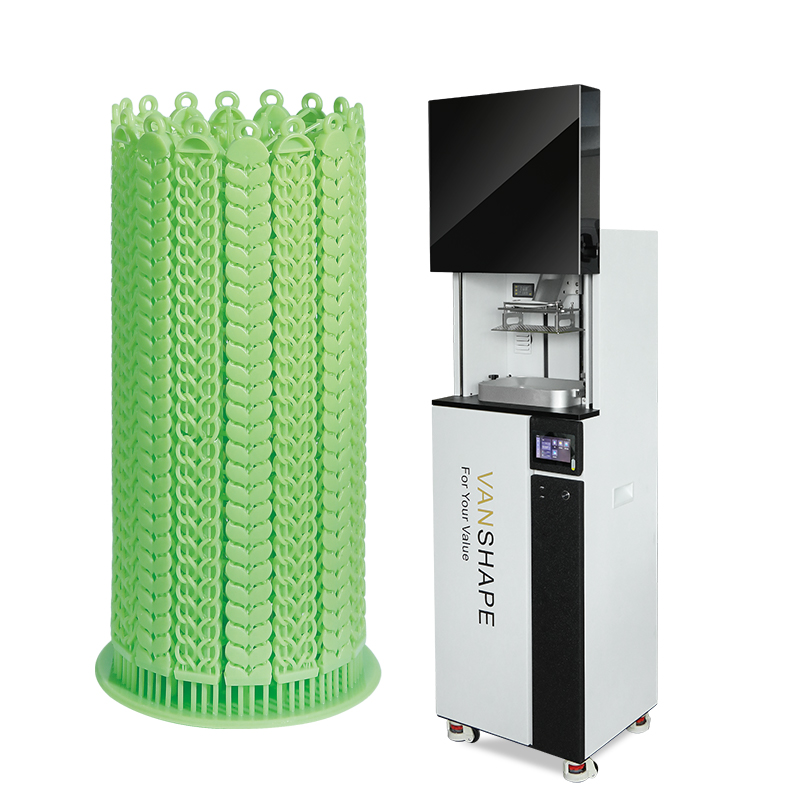
Silicone Rubber (80°C to 120°C): Silicone rubber molds cure at significantly lower temperatures than natural rubber. The specific temperature depends on the silicone formulation. Addition-cure silicones typically process at 100°C to 120°C, while condensation-cure silicones cure at room temperature or at 60°C to 80°C with heat acceleration. The lower temperature range reduces thermal stress on heat-sensitive master patterns, which is particularly valuable when using 3D-printed resin patterns that may distort at higher temperatures. Workshops using 3d jewelry printer technology for pattern production should consider silicone for this reason.
Temperature Uniformity: Regardless of the target temperature, uniformity between upper and lower platens is critical for high-detail molds. A temperature differential of more than 5°C between platens causes uneven curing, resulting in a mold with varying hardness across its thickness. Digital vulcanizers with dual-controller systems allow independent monitoring and adjustment of each platen, maintaining the differential within 1-2°C. This level of control is essential for high-detail mold production.
Pressure during vulcanization serves two critical functions: it compresses the uncured rubber sheets around the master pattern to eliminate air voids, and it ensures complete filling of all detail cavities in the pattern surface. Insufficient pressure produces molds with air pockets, incomplete detail reproduction, and parting line flash. Excessive pressure can distort the master pattern, particularly if it is made from softer materials like wax or resin.
Recommended Pressure by Frame Size:
| Frame Size (mm) | Recommended Pressure (tons) | Cross-link Density |
|---|---|---|
| 50 x 50 | 10-15 | Standard |
| 75 x 75 | 15-20 | Standard |
| 100 x 100 | 20-25 | Standard to High |
| 100 x 150 | 25-30 | High |
Pressure Application Method: Manual vulcanizers rely on the operator to turn a handwheel or lever to apply pressure, which introduces variability between operators and batches. Pneumatic and hydraulic vulcanizers apply pressure automatically, maintaining consistent force throughout the curing cycle. For high-detail mold production, automatic pressure systems are strongly recommended because they eliminate operator-dependent variability and maintain pressure even as the rubber softens and flows during initial heating.
Pressure Ramp: Rather than applying full pressure immediately, a staged pressure ramp produces superior mold quality. Initial light pressure (30% of target) allows the rubber to begin softening and conforming to the pattern surface. After 5-8 minutes, pressure is increased to 70% to force rubber into fine details and eliminate trapped air. Final pressure is applied at 10-12 minutes and maintained for the remaining cure time. This staged approach reduces the risk of pattern distortion and improves detail capture, particularly in deep recesses and undercut areas.
Curing time is the third parameter in the vulcanization equation, and it is interdependent with temperature and pressure. Higher temperatures accelerate the cross-linking reaction, reducing the required curing time, but also narrow the processing window and increase the risk of over-curing. Lower temperatures require longer curing times but provide a wider processing window and more uniform vulcanization throughout the mold thickness.
Mold Thickness Considerations: Thicker mold frames require longer curing times because heat must penetrate to the center of the mold. A general rule is that every additional 10mm of mold thickness requires approximately 8-12 additional minutes of curing time at standard temperatures. For high-detail molds, this means that larger, thicker frames should be processed at slightly lower temperatures with extended curing times to ensure uniform vulcanization from surface to center.
Determining Cure Completion: The most reliable method for confirming complete vulcanization is to test a small sample of the rubber compound cured alongside the main mold. After the curing cycle, the sample is pressed with a durometer to verify hardness is within the specified range. If the sample is under-cured, the main mold should be returned to the vulcanizer for additional time. In practice, most workshops develop standardized time-temperature profiles for their specific rubber compounds and frame sizes, using durometer testing for periodic verification.
The following settings provide starting points for common jewelry mold making scenarios. Actual parameters should be fine-tuned based on the specific rubber compound, equipment characteristics, and pattern material.
Scenario 1: Standard Ring Mold (Natural Rubber)
Temperature: 155°C (both platens)
Pressure: 15 tons (75 x 75mm frame)
Curing time: 40-45 minutes
Pressure ramp: 5 tons initial, 10 tons at 5 min, 15 tons at 10 min
Scenario 2: High-Detail Filigree Pendant (Natural Rubber)
Temperature: 150°C (both platens)
Pressure: 20 tons (100 x 100mm frame)
Curing time: 50-55 minutes
Pressure ramp: 6 tons initial, 12 tons at 8 min, 20 tons at 15 min
Scenario 3: Resin Pattern Reproduction (Silicone)
Temperature: 100°C (both platens)
Pressure: 15 tons (75 x 75mm frame)
Curing time: 30-40 minutes
Vacuum degassing: Required before press closing
Scenario 4: Bracelet Mold (Natural Rubber)
Temperature: 160°C (both platens)
Pressure: 25-30 tons (100 x 150mm frame)
Curing time: 55-65 minutes
Pressure ramp: 8 tons initial, 15 tons at 8 min, 25-30 tons at 15 min
For workshops managing multiple production lines, jewelry casting equipment with programmable settings allows these profiles to be stored and recalled, ensuring consistency across operators and production batches.
Optimizing vulcanizer temperature and pressure settings is a technical discipline that directly impacts jewelry mold quality, detail reproduction, and mold lifespan. The interplay between temperature, pressure, and curing time must be understood and controlled for each rubber compound and frame configuration. High-detail molds benefit from moderate temperatures with longer curing times, staged pressure application, and precise platen temperature uniformity.
Workshops producing high-detail rubber molds should invest in vulcanizers with digital temperature control, dual-platen monitoring, and automatic pressure regulation. Explore the range of mold making equipment for jewelry from Yihui Casting to find vulcanizer models that meet the precision requirements of your production environment.
 online service
Scan to wechat :